Posts Tagged ‘Sacrament’

What are Mormon Meetings Like?

Friday, June 19th, 2009

Mormons are rather known for being a meeting people. They have meetings and they have meetings to plan meetings. But what do they do at all these meetings?

3335

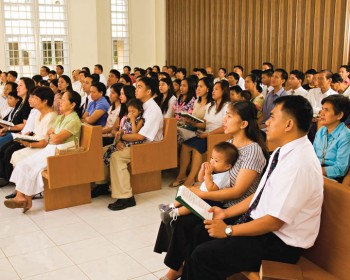
The most important meeting is Sacrament Meeting. This is held each Sunday and is the primary worship service. Because Mormons are run by a lay clergy, the bishop, who is the equivalent of a pastor, does not give the sermon each week. Every part of the meeting is done by someone donating his time and talents.

The meeting is held in the chapel, which is very simply designed. There are no statues, and newer buildings don’t have pictures. There is a “stand” which is a raised area at the front of the room. This contains seating for the choir, leadership, and speakers, and usually also contains a piano and an organ. There is a podium which sometimes has flowers and always has tissues because Mormons tend to cry when they feel the spirit strongly.

As worshippers arrive, prelude music is played by a volunteer. The meeting opens with a member of the bishopric-the bishop or one of his two counselors-welcoming everyone and conducting any necessary business. There is an opening song led by a chorister and a prayer given by any adult or teenaged member of the congregation who is invited to do so. Women are allowed to pray and preach in Mormon meetings. The prayer is given in the member’s own words.

Sometimes a person is confirmed a new member of the church or a baby is blessed (similar to a christening.)

After these preliminaries, and when announcements and information about who has been invited to fill church positions recently has been handled, the sacrament portion of the meeting begins. This is the primary reason for the meeting to be held. At this time, the members of the congregation sing a song about the death or resurrection of the Savior, Jesus Christ. Then the Sacrament is blessed and passed to the congregation.

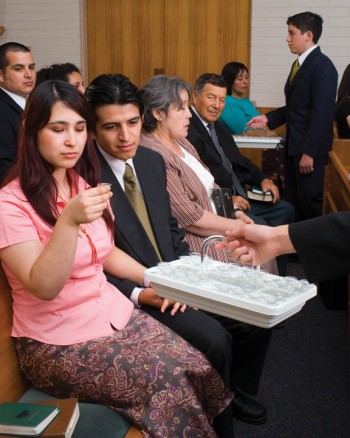
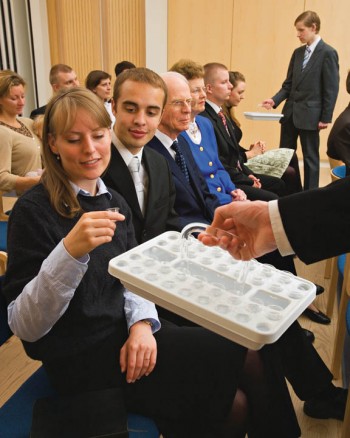
The Sacrament is blessed by boys or men who hold the priesthood. The priesthood holder must be at least sixteen years old. They stand in one corner of the stand at the front of the room at an alter. One priesthood holder says the prayer, which is one of the few prescribed prayers in the church, to bless the bread. Boys or men who are at least twelve years old take the trays from the people who blessed the sacrament and take it out into the congregation. These prayers can be read in the Doctrine and Covenants. This is followed by the blessing and passing of the water. The trays are taken to the ends of rows. Members take their portion and then hold the tray for the person sitting beside them as he or she takes it. A person who is not a member of the church can simply take the tray and hold it for the next person, without partaking.

The taking of the Sacrament allows members to renew promises they made to God at baptism and reminds them of the atonement of Jesus Christ. As the sacrament is passed, members sit quietly and think about Jesus or read their scriptures. Young children often look at pictures of Jesus during this time.

When this is finished, several members of the congregation give talks or brief sermons. This time often begins with five minute talks by one or two teenagers, followed by longer talks given by adults. Both men and women are invited by a leader to speak and are assigned a topic. The meeting is generally focused on a single theme chosen by leaders for that week. In this way, the speakers have been given an opportunity to study a topic for a week and then to share their insights, favorite scriptures, and meaningful quotes related to the topic. The congregation gains the insights of many different people over the course of a year.

There is sometimes an intermediate hymn midway through the talks.

At the end of the meeting, there is a song and a prayer, again given by a member of the congregation, and members are dismissed to go to classes.

It’s important to note that children attend the Sacrament Service with their families. There is no nursery for this portion of the day. This means Mormon services are sometimes a bit noisy, but members feel it is important for children to attend this service and to have lifelong memories of worshipping with their children. Many parents bring quiet books or toys for the youngest children. Despite this, there can be a fair amount of noise and even the occasional escapee, a toddler who gets away from his parents and decides to go visit the bishop up on the stand. However, the Savior made it very clear during his ministry that children matter to the Lord and that we must not turn them away. Mormons are accepting of the necessary distractions of children in meetings, even as they strive to teach their children to behave.

After the Sacrament meeting, people move on to various classes. Children who are eighteen months to age three attend a nursery class, which is not just a playtime, but is an actual class with lessons, music, and educational activities. Children ages three to twelve attend Primary. During half of Primary, they are in classes divided by age. The other half, they are in Sharing Time, where they are with all the children in Primary or half of them, divided by age. Here they have a participatory lesson and a music time.

Teenagers attend Sunday School with students their own age, and then split into two groups, one for boys and one for girls. They attend a class that helps them learn the practical aspects of the gospel-how to take the doctrine and apply it to everyday life. During the week, they will have a week day activity once a week, and those fourteen and older will attend a daily scripture study class.

Adults begin with Sunday School, and then they too split into groups according to gender. Men attend a priesthood lesson, even if they don’t yet have the priesthood, and women attend Relief Society, an auxiliary that focuses on service and gospel education. Although the two groups study much the same thing, they do so from the perspective of their roles in life.

This entire process of three meetings takes three hours. Because the Sabbath is set aside for worship, this does not in any way impact the day for members. Even when they return home, they will keep the Sabbath Day holy, as God commanded, and continue with family or private worship, study, and contemplation.

Mormon meetings tend to be very simple. They are run by volunteers and are focused on the mission of the church, which is to bring people to Christ.

  • Share/Bookmark

Do Mormons Abstain From Meat on Fridays?

Tuesday, March 24th, 2009

Catholics teach that Christ died on Friday, and for that reason, they follow special penitential observances on Fridays, willingly suffering as He suffered, and traditionally, this has required the sacrifice of the eating of meat, something many people enjoy. They use Friday as a special time to draw closer to God, to become aware of their sins, and to work to overcome them. Although the bishop’s counsil suggests this is now voluntary, but encouraged, Catholics are still asked to use Friday as a day to draw closer to God and can substitute other penances. (Pastoral Statement on Penance and Abstinence A Statement Issued by the National Conference of Catholic Bishops November 18, 1966)

Mormons do not abstain from meat, but there are other ways in which they too draw closer to God and focus on seeking forgiveness of and abandonment of their sins.

74

One such method is the weekly taking of the Sacrament. Mormons are baptized for the remission of their sins at age eight, which Mormons consider the age of accountability. Thereafter, sins are repented of as they occur. Each week, during the Sacrament Service (the basic worship service), Mormons partake of the Sacrament of bread and water, in remembrance of the death of the Savior. At that time they renew the covenants they’ve made with him. While they needn’t be perfect to partake, they are expected to prepare themselves for the taking of the Sacrament by having examined their lives and repented of their sins.

Another way Mormons sacrifice for God is through a monthly fast. The first Sunday of each month they abstain from all food and drink for twenty-four hours, which involves skipping two meals. For instance, they might start their fast immediately following a late lunch on Saturday afternoon, and resume with a late lunch on Sunday afternoon. They arrive at a special church service having fasted nearly the entire twenty-four hour period. They donate the money saved by doing so to a special fund, called a fast offering, to meet the needs of the poor. During the course of the fast, they’re expected to spend their time in spiritual pursuits as far as possible, studying, praying, and reflecting. This is, like the Catholic penance, a time to grow closer to God and to reflect on our spiritual progress. It’s also a time to pray for any exceptional needs we might have, or that others we care about might have.

Mormons are taught to spend time contemplating the great sacrifices the Savior made on our behalf, both in Calvary, where He took our sins upon himself, and on the cross, when He died for us.

The picture we often see of the Savior kneeling in the Garden of Gethsemane can’t begin to help us understand what the Savior, Jesus Christ, endured that day for us, the day He took on our sins and began the process of becoming our redeemer. He endured a pain greater than any of us can imagine, and He did it alone. His friends were asleep. His earthly family wasn’t there. His Father in Heaven withdrew and did not-could not for our sakes-intercede. This was something the Savior had to do alone, just for us, without help, and He did. He could have stopped it. He could have turned away from the pain and suffering, and gone back out into the world, but He didn’t. He stayed and gave us the redemption from our sins.

Gordon B. Hinckley, the former Mormon prophet, said:

“He lives, the Savior and Redeemer of all mankind, whose Atonement came as an act of grace for the entire world. … He has done for us what we could not do for ourselves. He has brought meaning to our mortal existence. He has given us the gift of eternal life. … God be thanked for the gift of His Son, the Redeemer of the world, the Savior of mankind, the Prince of Life and Peace, the Holy One” (“A Testimony of the Son of God,” Liahona and Ensign, Dec. 2002, 4-5).

  • Share/Bookmark

Do Mormons Have Mass?

Friday, March 20th, 2009

Catholics have mass to show adoration to the Savior. They teach Jesus offered Mass at the Last Supper and that the bread and wine offered during mass are literally transformed into the Savior’s blood and body.

887

Mormons have a similar celebration, called the Sacrament. It is offered during a weekly Sacrament Meeting, which is the primary worship service. There are differences between the Ca

tholic and Mormon service, however.

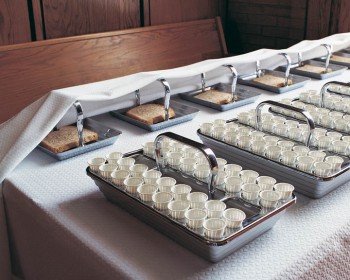
Mormons use bread and water in the Sacrament. Although wine was used when Christ held the first Sacrament, Mormons teach that the bread and water only represent the blood and body of the Savior, rather than being transformed into the actual blood and body, and therefore, it is not important that water is used instead.

Joseph Smith received the following revelation from God:

2 For, behold, I say unto you, that it mattereth not what ye shall eat or what ye shall drink when ye partake of the sacrament, if it so be that ye do it with an eye single to my glory-remembering unto the Father my body which was laid down for you, and my blood which was shed for the remission of your sins.

3 Wherefore, a commandment I give unto you, that you shall not purchase wine neither strong drink of your enemies; (Doctrine and Covenants 27)

Mormons do not drink alcohol. They follow a health code that prohibits it. In addition, water is easily obtained and requires no special purchase. Because Mormons consider the sacrament to be in remembrance of the Savior, they are focused on the meaning, rather than the specific items taken. However, the Sacrament does follow a carefully prescribed format and has one of the few specific prayers used in the church. In most cases, Mormon prayers are personalized by the giver, but the Sacrament prayers must be given exactly.

The Sacrament is prepared by priesthood holders. Boys who are at least sixteen may serve as priests, which is not the same as a priest in the Catholic Church. It is merely one office in the priesthood. The priests tear the bread into small pieces and then bless it (say a prayer.) They give the trays to the deacons, who go out among the congregation, distributing it. Boys ages twelve and thirteen may serve as deacons. The congregation remains seated throughout the Sacrament.

The bread is broken into small pieces by two priests, representing the way Christ’s body was broken on the cross.

The water represents the blood that was shed for us. It is placed in small disposable cups and is prayed over by the second priest.

The prayers are given to us in modern revelation, and outlines both the purpose of the Sacrament and how the church members are to approach it.  Note that the prayers were outlined prior to the change from wine to water.

75 It is expedient that the church meet together often to partake of bread and wine in the remembrance of the Lord Jesus;

76 And the elder or priest shall administer it; and after this manner shall he administer it-he shall kneel with the church and call upon the Father in solemn prayer, saying:

77 O God, the Eternal Father, we ask thee in the name of thy Son, Jesus Christ, to bless and sanctify this bread to the souls of all those who partake of it, that they may eat in remembrance of the body of thy Son, and witness unto thee, O God, the Eternal Father, that they are willing to take upon them the name of thy Son, and always remember him and keep his commandments which he has given them; that they may always have his Spirit to be with them. Amen.

78 The manner of administering the wine-he shall take the cup also, and say:

79 O God, the Eternal Father, we ask thee in the name of thy Son, Jesus Christ, to bless and sanctify this wine to the souls of all those who drink of it, that they may do it in remembrance of the blood of thy Son, which was shed for them; that they may witness unto thee, O God, the Eternal Father, that they do always remember him, that they may have his Spirit to be with them. Amen. (Doctrine and Covenants 20)

Mormons are taught to prepare carefully for the Sacrament. During the week, they evaluate their lives and repent of any sins they may have committed. They try to arrive at the meeting feeling spiritual. As the bread and water are being passed, the room is silent (except for babies and small children) and members are encouraged to read scriptures or think about the Savior, Jesus Christ. It’s a time to reflect on Him and on the wonders of the Atonement in our lives.

Although Mormons and Catholics might approach the Sacrament a bit differently, the purpose is the same: To show love and honor to the Savior.

  • Share/Bookmark

What does the Sacrament mean to a Mormon?

Tuesday, March 10th, 2009

Personal Response by Bethany

To a Mormon, the Sacrament is very personal because it provides an opportunity for members to think about the great life, ministry, and Atonement of the Savior and how it applies and affects their individual lives. As written in the Encyclopedia of Mormonism, “the Sacrament focuses attention on the sacrifice for sin wrought by the Savior and the need for all those who have been baptized to maintain their lives constantly in harmony with his teachings and commandments.”  The word “Sacrament” refers to the Lord’s Supper in which Christ used emblems in similitude of the sacrifice He was soon to make.  Christ met with His Apostles and instituted the sacrament as written in Luke 22:19-20:

19 And he took bread, and gave thanks, and brake it, and gave unto them, saying, This is my body which    is given for you: this do in remembrance of me.

20 Likewise also the cup after supper, saying, This cup is the new testament in my blood, which is shed for you.

The broken bread reminds Church members of the Savior’s body, His suffering, and that through His mercy everyone will be resurrected and given the opportunity to obtain eternal life.  The water is symbolic of the Savior shedding His blood in suffering and anguish which started in the Garden of Gethsemane and ended on the cross.

  • Share/Bookmark

Do Mormons have Communion?

Wednesday, March 19th, 2008

Personal Response by Karen Merkley

Mormons partake of the Sacrament of the Lord’s supper–initiated by Jesus Christ–every Sunday, as Catholics partake of Communion. We have in common our love of the Lord, and our belief that He would have us partake of this emblem of His love, sacrifice and atonement.

In addition to partaking of the Sacrament as the emblem of Christ’s sacrifice and as an ordinance through which members of the Church renew their baptismal covenants, Mormons do so in a prescribed manner, which was revealed to the prophet Joseph Smith, and is recorded in a book of revelations known as The Doctrine and Covenants–a scriptural record of the Lord’s instructions to Joseph as the Lord’s Church was restored to the earth.

For Mormons, the prescribed manner of administering the blessing of the bread is set forth as follows:

  • Share/Bookmark