Posts Tagged ‘priesthood’

What are Mormon Meetings Like?

Friday, June 19th, 2009

Mormons are rather known for being a meeting people. They have meetings and they have meetings to plan meetings. But what do they do at all these meetings?

3335

The most important meeting is Sacrament Meeting. This is held each Sunday and is the primary worship service. Because Mormons are run by a lay clergy, the bishop, who is the equivalent of a pastor, does not give the sermon each week. Every part of the meeting is done by someone donating his time and talents.

The meeting is held in the chapel, which is very simply designed. There are no statues, and newer buildings don’t have pictures. There is a “stand” which is a raised area at the front of the room. This contains seating for the choir, leadership, and speakers, and usually also contains a piano and an organ. There is a podium which sometimes has flowers and always has tissues because Mormons tend to cry when they feel the spirit strongly.

As worshippers arrive, prelude music is played by a volunteer. The meeting opens with a member of the bishopric-the bishop or one of his two counselors-welcoming everyone and conducting any necessary business. There is an opening song led by a chorister and a prayer given by any adult or teenaged member of the congregation who is invited to do so. Women are allowed to pray and preach in Mormon meetings. The prayer is given in the member’s own words.

Sometimes a person is confirmed a new member of the church or a baby is blessed (similar to a christening.)

After these preliminaries, and when announcements and information about who has been invited to fill church positions recently has been handled, the sacrament portion of the meeting begins. This is the primary reason for the meeting to be held. At this time, the members of the congregation sing a song about the death or resurrection of the Savior, Jesus Christ. Then the Sacrament is blessed and passed to the congregation.

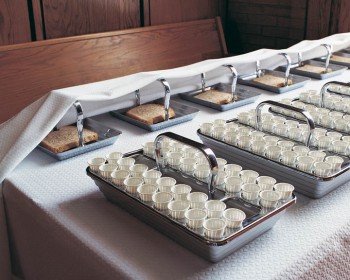
The Sacrament is blessed by boys or men who hold the priesthood. The priesthood holder must be at least sixteen years old. They stand in one corner of the stand at the front of the room at an alter. One priesthood holder says the prayer, which is one of the few prescribed prayers in the church, to bless the bread. Boys or men who are at least twelve years old take the trays from the people who blessed the sacrament and take it out into the congregation. These prayers can be read in the Doctrine and Covenants. This is followed by the blessing and passing of the water. The trays are taken to the ends of rows. Members take their portion and then hold the tray for the person sitting beside them as he or she takes it. A person who is not a member of the church can simply take the tray and hold it for the next person, without partaking.

The taking of the Sacrament allows members to renew promises they made to God at baptism and reminds them of the atonement of Jesus Christ. As the sacrament is passed, members sit quietly and think about Jesus or read their scriptures. Young children often look at pictures of Jesus during this time.

When this is finished, several members of the congregation give talks or brief sermons. This time often begins with five minute talks by one or two teenagers, followed by longer talks given by adults. Both men and women are invited by a leader to speak and are assigned a topic. The meeting is generally focused on a single theme chosen by leaders for that week. In this way, the speakers have been given an opportunity to study a topic for a week and then to share their insights, favorite scriptures, and meaningful quotes related to the topic. The congregation gains the insights of many different people over the course of a year.

There is sometimes an intermediate hymn midway through the talks.

At the end of the meeting, there is a song and a prayer, again given by a member of the congregation, and members are dismissed to go to classes.

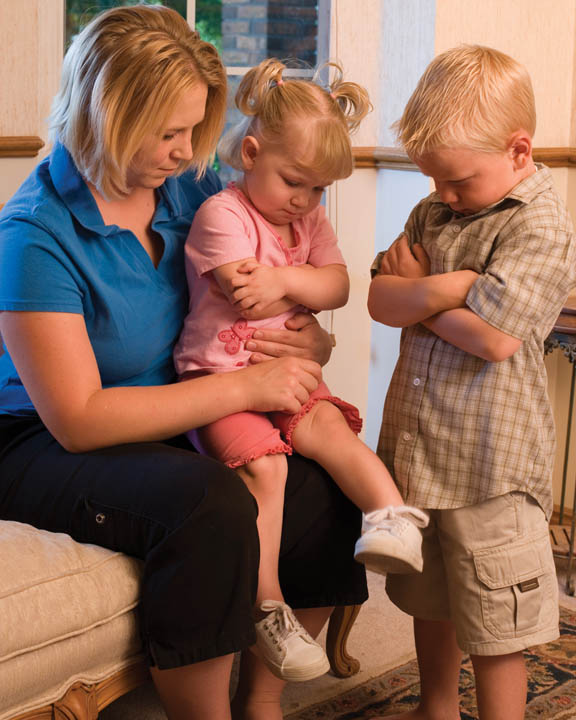
It’s important to note that children attend the Sacrament Service with their families. There is no nursery for this portion of the day. This means Mormon services are sometimes a bit noisy, but members feel it is important for children to attend this service and to have lifelong memories of worshipping with their children. Many parents bring quiet books or toys for the youngest children. Despite this, there can be a fair amount of noise and even the occasional escapee, a toddler who gets away from his parents and decides to go visit the bishop up on the stand. However, the Savior made it very clear during his ministry that children matter to the Lord and that we must not turn them away. Mormons are accepting of the necessary distractions of children in meetings, even as they strive to teach their children to behave.

After the Sacrament meeting, people move on to various classes. Children who are eighteen months to age three attend a nursery class, which is not just a playtime, but is an actual class with lessons, music, and educational activities. Children ages three to twelve attend Primary. During half of Primary, they are in classes divided by age. The other half, they are in Sharing Time, where they are with all the children in Primary or half of them, divided by age. Here they have a participatory lesson and a music time.

Teenagers attend Sunday School with students their own age, and then split into two groups, one for boys and one for girls. They attend a class that helps them learn the practical aspects of the gospel-how to take the doctrine and apply it to everyday life. During the week, they will have a week day activity once a week, and those fourteen and older will attend a daily scripture study class.

Adults begin with Sunday School, and then they too split into groups according to gender. Men attend a priesthood lesson, even if they don’t yet have the priesthood, and women attend Relief Society, an auxiliary that focuses on service and gospel education. Although the two groups study much the same thing, they do so from the perspective of their roles in life.

This entire process of three meetings takes three hours. Because the Sabbath is set aside for worship, this does not in any way impact the day for members. Even when they return home, they will keep the Sabbath Day holy, as God commanded, and continue with family or private worship, study, and contemplation.

Mormon meetings tend to be very simple. They are run by volunteers and are focused on the mission of the church, which is to bring people to Christ.

  • Share/Bookmark

Mormon Women and Priesthood

Monday, June 15th, 2009
3326

People often ask why Mormons don’t have female priesthood leaders. Today, there are still many churches, including The Church of Jesus Christ of Latter-day Saints, that do not have women in the priesthood, having noted from their study of the Bible that this was not the way it was done. Jesus had many women who followed Him, and whom He pointed out as outstanding examples of gospel living, but He didn’t select any of them to be His apostles. It was not that He considered them unable to do the work, or unworthy of the role; it was simply not the role assigned to women by God.

  • Share/Bookmark

What is Confirmation Like for Mormons?

Tuesday, March 24th, 2009

Mormon children can be confirmed members of the church at the age of eight. Converts older than eight are confirmed soon after their baptisms.

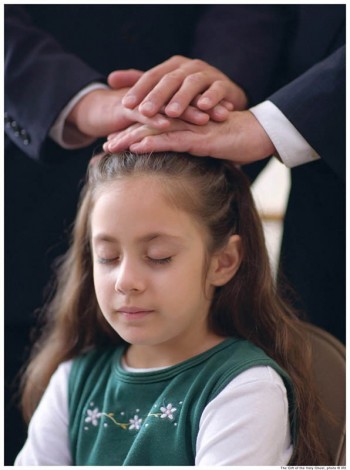
The confirmation is a very simple procedure. The person being confirmed sits in a chair, with arms folded for the prayer that is about to begin. Men who hold the proper level of Mormon priesthood and who have been invited by the person being confirmed, gather around the seated person. They each place one hand on the child’s head, and one on the shoulder of the man next to them. The child will have previously decided who will confirm her. Since all worthy male members of the church of the proper age can hold the priesthood, this is usually the child’s father. If the father doesn’t hold the priesthood or isn’t living, any other priesthood holder can be selected.

The confirmation is done formally, with the priesthood holder simply confirming the child a member of the church in selected language, and then telling the child to receive the gift of the Holy Ghost. The child does not publicly respond to this, but does so in her own heart. Then a special blessing is bestowed on the child. There is not a prescribed method for this. The priesthood holder offers the blessing in whatever words are given to him by God. Often these include words of advice from God or a bit of information about God’s plan for that person. The confirmation concludes in the name of Jesus Christ. Then t

854

he child (or anyone being confirmed) stands and shakes hands with the men who participated, and usually hugs the family members.

After everyone has returned to their seats, a church leader invites the new member to stand and he or she is presented to the congregation as the newest member of that congregation. Members are invited to raise their right hand to demonstrate their welcome and their commitment to supporting the new member in her church membership.

Confirmation is most often done in church the Sunday following the baptism, but is occasionally done right after the baptism.

A convert (anyone who joins the church after his ninth birthday) prepares for this moment by meeting with missionaries to learn about the church. They are expected to make an informed decision. While they won’t know everything at baptism, they need to know how to pray to learn God’s will concerning this choice, and they need to have a basic understanding of the church’s teachings. They are taught about God, Jesus Christ, the scriptures, and a few basic principles of the religion. They must also attend church several times to find out what it is like.

A child who joins will have been preparing for this moment from birth, or since his parents became members of the church. They learn gradually more complex gospel principles in formal church instruction on Sundays beginning at the age of eighteen months. They are also taught at home. Families are encouraged to hold a family home evening each Monday, in which family members teach each other their religion. They also have family prayer and daily scripture study together. By the time the child is ready to be baptized, he has a firm foundation in his religion and knows how to pray.

Even at the age of eight, children are expected to pray and to ask God if they should join the church. They, like adult converts, must demonstrate a basic understanding of their religion and to have a testimony of their own.

  • Share/Bookmark

How can Mormons have authority when the unbroken line of succession comes from Peter?

Wednesday, March 18th, 2009

Mormon beliefs teach that the church is the restoration of the church that existed in the days of the ministry of Jesus Christ. They teach that their priesthood is an unbroken line of authority. This puzzles those who teach that the line of succession comes from Peter and was never broken.

When Jesus chose His apostles, he gave them the authority to act for God. He held the keys to the kingdom, but could distribute them to those called of God.

18 And I say also unto thee, That thou art Peter, and upon this rock I will build my church; and the gates of hell shall not prevail against it.

19 And I will give unto thee the keys of the kingdom of heaven: and whatsoever thou shalt bind on earth shall be bound in heaven: and whatsoever thou shalt loose on earth shall be loosed in heaven. (Matthew 16)

These keys, of course, are not physical. They represent the authority to act in God’s name. The verse just quoted does not mean Jesus relinquished the keys, but rather that Peter had use of them during the time he served as an apostle. Many have interpreted the rock to be Peter, but other verses in the New Testament tell us this is not so:

And did all drink the same spiritual drink: for they drank of that spiritual Rock that followed them: and that Rock was Christ. (1 Corinthians 10:4)

In time, Jesus died. His apostles also died, and we don’t read of Peter or any other apostle bestowing those keys on anyone else. This is because after the death of the apostles, the church entered into a lengthy apostasy. This apostasy had been prophesied by many Biblical prophets.

11 Behold, the days come, saith the Lord God, that I will send a famine in the land, not a famine of bread, nor a thirst for water, but of hearing the words of the Lord:

12 And they shall wander from sea to sea, and from the north even to the east, they shall run to and fro to seek the word of the Lord, and shall not find it. (Amos 8:11-12)

During this time, there wasn’t a prophet, and the keys of the kingdom-the priesthood authority to administer God’s church was taken. It was because of those so many variations of Christianity occurred. With no one to turn to for a certain answer, Christians were forced to decide for themselves what was true. When there was a disagreement, they held councils to hammer out a deal or they just started another Christian denomination. Today, we see thousands of denominations across the world.

God has also promised to restore what was lost.

20 And he shall send Jesus Christ, which before was preached unto you:

21 Whom the heaven must receive until the times of restitution of all things, which God hath spoken by the mouth of all his holy prophets since the world began. (Acts 3)

There couldn’t be a restitution if there had never been a falling away. This restitution began with Joseph Smith in the 1800s. He wanted to know which church to join, and asked God in prayer. God and Jesus Christ appeared to him and Jesus told him not to join any of them, because none had the complete truth. When he was older, an angel named Moroni tutored him in preparation for the restitution of all things that was promised in the Book of Acts.

671

So how did the keys for the priesthood end up back on earth? While Joseph Smith and Oliver Cowdery were translating the Book of Mormon, they encountered scriptures on the importance of baptism by those in authority. They went to the banks of a river in Pennsylvania, where they were then living, and prayed to know how to go about this. While praying, they heard the voice of the Savior and then an angel appeared to them. This angel was John the Baptist, the Savior’s cousin. He held the keys to the Aaronic priesthood at the time of his death and was therefore able to restore them to the earth by distributing those keys to Joseph and Oliver by placing his hands on their heads and performing the appropriate priesthood ordinace. He did this, saying,

Upon you my fellow servants, in the name of Messiah, I confer the Priesthood of Aaron, which holds the keys of the ministering of angels, and of the gospel of repentance, and of baptism by immersion for the remission of sins; and this shall never be taken again from the earth until the sons of Levi do offer again an offering unto the Lord in righteousness. (Joseph Smith-History 1:68-74)

With these keys in place, the two men were able to baptize each other. Only the Aaronic priesthood is needed to carry out a baptism.

John had not received the Melchizedek priesthood, however, because it was bestowed on the apostles after his death. Since he didn’t hold those keys, he was not able to restore them. For the line to be unbroken, the keys must come from someone who holds them currently. This higher priesthood would be necessary to confer the Gift of the Holy Ghost, and to organize the church.

The restoration of the Melchizedek priesthood came later. Again, while praying on the banks of the Susquehanna River, they received an angelic visit, this time from Peter, James, and John. These three apostles received the greater priesthood on the Mount of Transfiguration.

We can read about this event in Matthew 17. Jesus took Peter, James, and John to a mountain, where he was transfigured. While this occurred, Moses and Elias appeared to them. The Mechizedek priesthood was restored to the earth by these two prophets, who had received it during their time on earth. They gave it to Peter, James, and John so they would be able to administer the gospel after the Savior died.

Because they held this priesthood, they were able to return to earth as angels and bestow the keys on Joseph and Oliver, again bringing the priesthood back to earth. With these keys, the church could be restored.

This is how the Mormons demonstrate an unbroken chain of authority. Today, every worthy male who is old enough can hold these two priesthoods. They must receive it from someone else who already holds it. The entire priesthood chain has descended from those first two ordinations done by three Biblical apostles.

  • Share/Bookmark

What does the Sacrament mean to a Mormon?

Tuesday, March 10th, 2009

Personal Response by Bethany

To a Mormon, the Sacrament is very personal because it provides an opportunity for members to think about the great life, ministry, and Atonement of the Savior and how it applies and affects their individual lives. As written in the Encyclopedia of Mormonism, “the Sacrament focuses attention on the sacrifice for sin wrought by the Savior and the need for all those who have been baptized to maintain their lives constantly in harmony with his teachings and commandments.”  The word “Sacrament” refers to the Lord’s Supper in which Christ used emblems in similitude of the sacrifice He was soon to make.  Christ met with His Apostles and instituted the sacrament as written in Luke 22:19-20:

19 And he took bread, and gave thanks, and brake it, and gave unto them, saying, This is my body which    is given for you: this do in remembrance of me.

20 Likewise also the cup after supper, saying, This cup is the new testament in my blood, which is shed for you.

The broken bread reminds Church members of the Savior’s body, His suffering, and that through His mercy everyone will be resurrected and given the opportunity to obtain eternal life.  The water is symbolic of the Savior shedding His blood in suffering and anguish which started in the Garden of Gethsemane and ended on the cross.

  • Share/Bookmark