Posts Tagged ‘Joseph Smith’

Our Faith is Centered in Jesus Christ

Tuesday, August 18th, 2009

Recently, Elder Russell M. Ballard spoke to graduating students at Brigham Young University, a school owned by The Church of Jesus Christ of Latter-day Saints. Members of this church are often informally known as Mormons. He counseled them in ways to discuss their religion with others, pointing out

3004

that most topics of greatest interest to detractors are not critical elements of the current religion, but are fringe elements or practices no longer carried out. He advised them to keep the discussions focused on the core of the religion, the elements that affect salvation, rather than those that are merely interesting intellectual discussion points.

“When all is said and done, the most important thing about you and your testimony is that you base your beliefs on what Jesus Christ taught, and you try to follow Him by living your life in a way acceptable to our Heavenly Father and to the Lord.

This is your foundation. It was Joseph Smith’s foundation. He said: “The fundamental principles of our religion are the testimony of the Apostles and Prophets, concerning Jesus Christ, that He died, he was buried, and rose again the third day, and ascended into heaven; and all other things which pertain to our religion are only appendages to it.”

(See Elder M. Russell Ballard: Engaging Without Being Defensive.)

Every religion has information or writings that cover a wide spectrum of information. Some of this information is essential to the salvation of the believer, but much of it is not. For instance, we must know who created the world and believe that, but we don’t have to know exactly how long it took. That is merely interesting fodder for debate or curiosity, but has nothing to do with our salvation. It’s interesting to read the genealogy in the Old Testament, but there won’t be a test on it when we stand before the Savior in judgment. Some stories in the Bible are curious and we don’t really understand why a Biblical prophet made the choices he did, but most of the time, we don’t need to know.

What we do need to know is that God is our loving Father in Heaven, and Jesus Christ is His only begotten Son. Jesus died for us and is the only path through which we may return to God someday. We need to learn how to identify truth by communicating directly with God to learn it.

It is these things the Mormons focus on in their daily spiritual life. They work to build a loving relationship with God and Jesus Christ and to understand how They would have us live from day to day. They strive to be good family members and good citizens. They study the Savior’s life and then try to understand how to live that way themselves.

While groups who work to oppose the church often focus on unimportant intellectual games, the Mormons are busy trying to be like Jesus. When talking with a Mormon, it is important to remember they aren’t generally very interested in those fringe topics. Their testimony isn’t based on history or science, but on faith. This faith came about after developing a close and personal relationship with God and then trusting Him to answer their questions in ways they could understand. They worked to know God so well they easily recognize Him when He communicates with them.

There is little purpose in presenting a Mormon who really knows Christ with the teachings of men, which are unreliable and changing. They aren’t interested in using those teachings as a foundation for their eternal salvation. They know the Creator, and it is only His words that matter.

  • Share/Bookmark

How Did Joseph Smith Learn Hebrew?

Monday, May 18th, 2009

Joseph Smith received very little formal education as a child and young man. He was largely educated by his parents, due to a lack of schools available. In all, he attended formal schooling only about three years. In addition, he was tutored by an angel named Moroni in spiritual things for several years prior to beginning his work. Despite this, by the time of his early death, he had become well-educated in many fields, including Hebrew.

  • Share/Bookmark

How Do Reason and Faith Work Together?

Wednesday, April 29th, 2009

The intellect is very important. God gave it to us and expects us to use it. We can take it with us when we die and the knowledge we gain in each stage of life will also go with us. However, the intellect is not the most important part of us, nor is it the source of absolute knowledge of truth.

  • Share/Bookmark

Do Mormons Have Mass?

Friday, March 20th, 2009

Catholics have mass to show adoration to the Savior. They teach Jesus offered Mass at the Last Supper and that the bread and wine offered during mass are literally transformed into the Savior’s blood and body.

887

Mormons have a similar celebration, called the Sacrament. It is offered during a weekly Sacrament Meeting, which is the primary worship service. There are differences between the Ca

tholic and Mormon service, however.

Mormons use bread and water in the Sacrament. Although wine was used when Christ held the first Sacrament, Mormons teach that the bread and water only represent the blood and body of the Savior, rather than being transformed into the actual blood and body, and therefore, it is not important that water is used instead.

Joseph Smith received the following revelation from God:

2 For, behold, I say unto you, that it mattereth not what ye shall eat or what ye shall drink when ye partake of the sacrament, if it so be that ye do it with an eye single to my glory-remembering unto the Father my body which was laid down for you, and my blood which was shed for the remission of your sins.

3 Wherefore, a commandment I give unto you, that you shall not purchase wine neither strong drink of your enemies; (Doctrine and Covenants 27)

Mormons do not drink alcohol. They follow a health code that prohibits it. In addition, water is easily obtained and requires no special purchase. Because Mormons consider the sacrament to be in remembrance of the Savior, they are focused on the meaning, rather than the specific items taken. However, the Sacrament does follow a carefully prescribed format and has one of the few specific prayers used in the church. In most cases, Mormon prayers are personalized by the giver, but the Sacrament prayers must be given exactly.

The Sacrament is prepared by priesthood holders. Boys who are at least sixteen may serve as priests, which is not the same as a priest in the Catholic Church. It is merely one office in the priesthood. The priests tear the bread into small pieces and then bless it (say a prayer.) They give the trays to the deacons, who go out among the congregation, distributing it. Boys ages twelve and thirteen may serve as deacons. The congregation remains seated throughout the Sacrament.

The bread is broken into small pieces by two priests, representing the way Christ’s body was broken on the cross.

The water represents the blood that was shed for us. It is placed in small disposable cups and is prayed over by the second priest.

The prayers are given to us in modern revelation, and outlines both the purpose of the Sacrament and how the church members are to approach it.  Note that the prayers were outlined prior to the change from wine to water.

75 It is expedient that the church meet together often to partake of bread and wine in the remembrance of the Lord Jesus;

76 And the elder or priest shall administer it; and after this manner shall he administer it-he shall kneel with the church and call upon the Father in solemn prayer, saying:

77 O God, the Eternal Father, we ask thee in the name of thy Son, Jesus Christ, to bless and sanctify this bread to the souls of all those who partake of it, that they may eat in remembrance of the body of thy Son, and witness unto thee, O God, the Eternal Father, that they are willing to take upon them the name of thy Son, and always remember him and keep his commandments which he has given them; that they may always have his Spirit to be with them. Amen.

78 The manner of administering the wine-he shall take the cup also, and say:

79 O God, the Eternal Father, we ask thee in the name of thy Son, Jesus Christ, to bless and sanctify this wine to the souls of all those who drink of it, that they may do it in remembrance of the blood of thy Son, which was shed for them; that they may witness unto thee, O God, the Eternal Father, that they do always remember him, that they may have his Spirit to be with them. Amen. (Doctrine and Covenants 20)

Mormons are taught to prepare carefully for the Sacrament. During the week, they evaluate their lives and repent of any sins they may have committed. They try to arrive at the meeting feeling spiritual. As the bread and water are being passed, the room is silent (except for babies and small children) and members are encouraged to read scriptures or think about the Savior, Jesus Christ. It’s a time to reflect on Him and on the wonders of the Atonement in our lives.

Although Mormons and Catholics might approach the Sacrament a bit differently, the purpose is the same: To show love and honor to the Savior.

  • Share/Bookmark

Does Religion Take Away Your Agency?

Tuesday, March 17th, 2009
719

This is a common misconception about religion. Mormons teach that each person is given agency to choose for himself how to live. Mormon beliefs begin the story of life prior to birth, when God created each of us as a spirit. We lived with Him, learning, developing our character and personality, and practicing making choices, until the time came to come to earth. At that time, we were, as always, given our agency. We could choose to come to earth with Jesus as our Savior. If we made this choice, we would continue to have agency and some would use it unwisely and be unable to return. God would send a Savior to do that part we couldn’t do for ourselves. This Savior, Jesus Christ, would take on the sins of the world and die for them.

The other choice was to follow Lucifer. Lucifer wanted to take away our agency and send us to earth as puppets, with himself as the puppet master. He would control our every thought and action, and we’d live perfect lives, but for no purpose. Some were uncomfortable with the idea of continued agency, and rejected it. They preferred to stay with Satan and allow him to do their thinking for them. Those who followed Lucifer elected to give up their agency and were denied a chance to come to earth. They could not live here without agency.

The Mormon religion allows us to maintain control over our lives. Mormons teach that each person is required to find out for himself if the Mormon religion is true. While a very young child might believe simply because his parents believe, the child is taught, before he is eight years old, to begin deciding for himself. At age eight, he can be baptized, and before this happens, he is to learn his religion and to pray to know if it’s true.

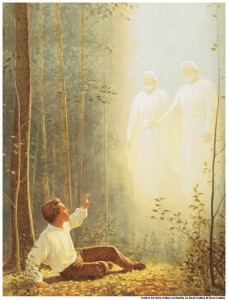
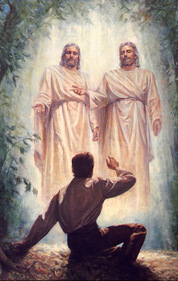
This process is often repeated several times, as the child grows up and gains a stronger ability to recognize the promptings of faith. The pattern was set for us by Joseph Smith, the first Mormon prophet of modern times. He wanted to know which church to join, and after reading in the Bible that God would tell him, he went into the woods to ask God. Both God and Jesus Christ came to him to answer His question.

Most of us won’t get that type of answer, but we can receive an answer to our prayers, just as Joseph Smith did.

Does joining a church force you to give up your right to think for yourself? Of course not. Because each member of the church is taught to find out for themselves if the church is true, they are making an informed decision. Even after making this overall choice, if they learn something they’re not sure about, they can pray about that specific doctrine as well.

If your mother taught you not to touch a hot stove, and you obey, have you given up your right to think for yourself? No, because you are still free to touch the stove, as long as you’re willing to accept the consequences. You’re simply choosing to do what you know is best for you. Mormons, and other who believe in God, are doing the same.

One example often given is that of the sonnet. The sonnet is a poem with a very strict structure. Within the strict structure, however, a great deal of originality is possible. There are millions of sonnets, all following the rules, but all unique.

Believing in God is comforting. It’s a safe and healthy comfort, unlike the artificial comfort brought about by alcohol, drugs, or other immoralities many people turn to when they are stressed or worried. People who believe in God know there is someone who loves them and knows them, who always has their best interests at heart, and who, while not taking away our personal agency, will help us if we ask for help.

A true religion asks a great deal of its members. The Mormon religion isn’t a passive one. Because it’s a lay church, each member works hard to help it function, serving as leaders, teachers, and givers of service. They are held to a high standard of behavior.

Giving up your right to think for yourself is seemingly easy (although in reality it isn’t.) People looking for an easy way through life aren’t interested in being Mormon. The moral standards are very high and, since Mormons live in the everyday world, not in a sheltered community, this means making sacrifices and fighting those who want them to lower their standards. They raise families, have jobs, do volunteer work, and are also taught to make the most of the talents they have been given. They must figure out how to do this on their own, given their unique circumstances.

Religion never promises to be easy. The Mormons expect people to work hard for their own happiness and well-being, using the gospel as a guideline, but making choices within those guidelines.

  • Share/Bookmark

What are Angels?

Tuesday, March 3rd, 2009

Angels are messengers from God and serve as ministering spirits. They’re spoken of often in both the Bible and the Book of Mormon, and play a critical role in the restoration of the gospel in modern times. There are two types of angels. The most common are resurrected beings—those who lived on earth, and then, after their deaths or translations (going to Heaven without dying), became angels. Some were those who lived exemplary lives on earth and will live with God. These often minister to those on earth, participating in critical events in the Earth’s spiritual history. Others are those who lived on earth, but did not keep the commandments well enough to return to God. These are spoken of in Matthew 22:29-30:

29 Jesus answered and said unto them, Ye do err, not knowing the scriptures, nor the power of God.

30 For in the resurrection they neither marry, nor are given in marriage, but are as the angels of God in heaven.

In these verses, Jesus explains that angels-not the exalted beings, but the unworthy beings-will not be allowed to have eternal families because they will not be exalted.

The Bible also mentions some who were angels without having been mortal previously.

No angels have wings. Clearly, those who lived on earth aren’t going to sprout wings, since they are, as we are, in the image of their Father in Heaven. Wings are merely an earthly attempt to explain how angels are able to move around in the sky, but have no bearing in fact. With God’s power behind them, wings are unnecessary.

Those who minister to those on earth are of particular interest to us today. We find them in nearly every important event in our spiritual history.

One important example of the work angels do is shown in the birth of the Savior, Jesus Christ. It was an angel, Gabriel, who came to Elisabeth to tell her she would have a son named John, and then to Mary to tell her that she would be the mother of Jesus. An angel-possibly also Gabriel-came to Joseph to reassure him that Mary’s child really was the promised Savior.

Angels also came to earth to announce the birth of the Savior:

8 And there were in the same country shepherds abiding in the field, keeping watch over their flock by night.

9 And, lo, the angel of the Lord came upon them, and the glory of the Lord shone round about them: and they were sore afraid.

10 And the angel said unto them, Fear not: for, behold, I bring you good tidings of great joy, which shall be to all people.

11 For unto you is born this day in the city of David a Saviour, which is Christ the Lord.

12 And this shall be a sign unto you; Ye shall find the babe wrapped in swaddling clothes, lying in a manger.

13 And suddenly there was with the angel a multitude of the heavenly host praising God, and saying,

14 Glory to God in the highest, and on earth peace, good will toward men.

15 And it came to pass, as the angels were gone away from them into heaven, the shepherds said one to another, Let us now go even unto Bethlehem, and see this thing which is come to pass, which the Lord hath made known unto us.

Angels remained a presence from time to time during the life of the Savior, for instance, ministering to Him as He suffered the extraordinary pain of taking on our sins in the Garden of Gethsemane.

In modern times, angels were the messengers who brought the restored gospel back to the earth. In the Book of Mormon, we read of Moroni, a prophet who was the last remaining righteous person in his personal world. He was a Nephite, as his people were known, and when his prophet father Mormon and the others of his people were killed, he inherited the records of his civilization. These records were sacred and would play a critical role in the restoration. They included details of the visit of Jesus Christ to the Americas after his crucifixion. Moroni abridged the records and buried them for safekeeping.

701

After his death, he became an angel. When it was time to restore the Savior’s full gospel to the earth, it was Moroni, fittingly, who came to earth as an angel to tutor Joseph Smith. When he felt Joseph was sufficiently matured and educated, he allowed Joseph to take the records from the hill where they’d been kept for safekeeping all these years.

Later, as Joseph and his friend Oliver Cowdery were working on the translation of these records, which would become known as the Book of Mormon, they read about baptism. They had questions about this ordinance and went to the banks of the Susquehanna River to pray. At this time, John the Baptist came to earth as an angel. He had baptized Jesus, and still held the keys (the authority) of the Aaronic Priesthood, which is mentioned in the Old Testament. This priesthood is required in order to perform a baptism. He bestowed those keys on Joseph and Oliver, who were then able to baptize each other.

There is an additional, higher priesthood called the Melchizedek Priesthood, which also needed to be restored in order for the church to function as it did in the days of the Savior’s ministry. These keys had also been taken from the earth after the death of the apostles, and again, angels came to deliver them to Joseph. The keys are not literal, physical keys, but are the authority to act for God. Peter, James, and John, who had been Jesus’ apostles during his mortal ministries, had received the keys to the Melchizedek priesthood from Jesus on the Mount of Transfiguration. They continued to hold them, since the world had been in apostasy, and so they came to bestow them on Joseph Smith and Oliver Cowdery. With all the keys now restored, the church itself could be restored.

The work of angels is critical to God’s plan. They are frequently present when the most important events occur and are an important part of our lives on earth.

  • Share/Bookmark

The Family of Jesus Christ

Friday, February 20th, 2009

The family of Jesus Christ consists of both an earthly and a heavenly component. His father, of course, is God. Jesus is literally God’s son. God is the creator of our spirits, making us all God’s children, but we all have earthly parents. Only Jesus is the literal child of an earthly mother and a Heavenly Father.

Jesus also had siblings. According to Dr. Robert J. Matthews, who, in 1974, was an associate professor of ancient scripture at Brigham Young University, we can estimate the number of siblings he had.

“We don’t know how many other children there were in the family, but the New Testament names four boys and lists some sisters. The Greek manuscripts are helpful here. Matthew speaks of “all” (Greek: pantai) his sisters (Matt. 13:56), suggesting more than two. The Greek term hai adelphia (the sisters) is used in the manuscripts, signifying a plurality-that is, three or more sisters. If the record had intended to convey that there were only two sisters, it is probable that the word pantai would not have been employed, but, instead, the word amphoterai, meaning “both,” would have been used.

Thus the household of Joseph and Mary apparently numbered at least five boys (including Jesus) and at least three girls-eight children-in addition to the parents.” (Robert J. Matthews, “Mary and Joseph,” Ensign, Dec 1974, 13)

Professor Matthews says in this article that there are two theories about these other children. One is that they were Joseph’s from a previous marriage, and that Mary stayed a virgin all her life. He points out if this were true, those children, older than Jesus, would have been the heirs to the Davidic line, not Jesus. In addition, Jesus was referred to as Mary’s firstborn child, not her only child.

It’s important to note that prophecy said Jesus must be born to a virgin. It does not say she had to remain a virgin after His birth.

The other theory is that these were the children of Joseph and Mary, making them Jesus’ half-brothers. In this case, they would be younger than Jesus.

The brothers are mentioned by name in the book of Mark, chapter six, verse 3, in the Bible: “Is not this the carpenter, the son of Mary, the brother of James, and Joses, and of Juda, and Simon? and are not his sisters here with us? And they were offended at him.”

In the next verse, Jesus responds with a suggestion of sadness in His words: “4 But Jesus said unto them, A prophet is not without honour, but in his own country, and among his own kin, and in his own house.” (Mark 6:4)

It appears He was not recognized as a prophet by His brothers at that time. In John 7, his brothers are pressuring him:

3 His brethren therefore said unto him, Depart hence, and go into Judaea, that thy disciples also may see the works that thou doest.

4 For there is no man that doeth any thing in secret, and he himself seeketh to be known openly. If thou do these things, shew thyself to the world.

5 For neither did his brethren believe in him.

Carlfred Broderick, who in 1987, was a professor of sociology at the University of Southern California, notes that when Jesus was in his hometown and the people wanted to push him off a cliff, there is no record of His brothers coming to His defense. (Carlfred B. Broderick, “The Brothers of Jesus: Loving the Unbelieving Relative,” Ensign, Mar 1987, 50)

629

Professor Broderick also reminds us that on the cross, Jesus turned over care of His mother to one of His apostles, not to His brothers. It was apparent none of them came to Calvary that day, to support their mother or to be there for Him.

It may be this challenge, having brothers who turned their backs on the truth, that caused Jesus to speak of the importance of finding the lost sheep and of converting others. He knew, like so many others who face the heartache of an unbelieving relative, how challenging it was to see a loved one go astray.

There was not a change of heart until Jesus was resurrected. At that time, he appeared to His brother, James. Only now, when they could see the proof of his divinity, did they have a change of heart and fully repent of their earlier disbelief. Later scriptures mention the brothers as leaders in the church, with James seeming to fulfill a particularly high role. Some wrote portions of the New Testament. It was James who wrote the scripture that launched the restoration of the gospel.

In James 1:5, he wrote:

If any of you lack wisdom, let him ask of God, that giveth to all men liberally, and upbraideth not; and it shall be given him.

Joseph Smith was fourteen years old when he read this passage in the Bible. He had been visiting various churches and trying to figure out how a person could tell which one to join. When he read this scripture, written by the Savior’s own brother, he realized this was the only way to know what God wanted. God knew which church was true. He went into woods and prayed. During the course of the prayer, God and Jesus Christ appeared to him. God introduced him to Jesus, who then instructed him not to join any of the churches, because none was entirely correct.

In a few years, when Joseph was grown, he would be mentored by an angel, who would prepare him to lead the restored gospel.

  • Share/Bookmark

What are the Articles of Faith?

Wednesday, October 29th, 2008

What are the Articles of Faith?

Personal Response by Bethany

Background:

In 1842, John Wentworth, editor of the Chicago Democrat, wrote to Joseph Smith requesting information for a friend who was writing a history of New Hampshire.  Joseph Smith’s response to this inquiry has become known as the “Wentworth Letter.”  The letter includes a brief history of the Church and significant events in its restoration.  It ends with thirteen statements that have become known as the Articles of Faith and are published in the Pearl of Great Price.

  • Share/Bookmark

Do Mormons worship Joseph Smith?

Friday, April 25th, 2008

first visionPersonal Response by Richard Neitzel Holzapfel

Members of The Church of Jesus Christ of Latter-day Saints (Mormon Church) revere Biblical prophets and apostles such as Moses, Isaiah, Jeremiah, Peter, James, and Paul. They believe the Lord continues to call prophets and apostles in this modern day. Among those prophets God has chosen today is Joseph Smith (1805-44), the first modern prophet.

In addition to reverencing prophets and apostles, Mormons believe, like all Christians, that “there is one God, and one mediator between God and men, the man Christ Jesus” (1 Timothy 2:5). Therefore, Mormons truly and sincerely worship God, the Eternal Father, in the name of the Jesus Christ-God’s unique Son. They worship no other man or women no matter who they are or what they have done.

  • Share/Bookmark