Posts Tagged ‘Holy Ghost’

ExMormon – Members who leave the Mormon Church

Wednesday, September 9th, 2009

In the strictest sense, the word exmormon simply refers to someone who chose to end his membership in the Church of Jesus Christ of Latter-day Saints. Members of the Church are sometimes referred to informally as Mormons, and so an ex-mormon is a former Mormon. However, the term is more commonly used to refer not to people who simply left and moved on, but to those who then devote themselves to attacking the church.

3223

There are many reasons a person might do this. While most people who leave a religion—any religion—simply join a new one or abandon organized religion and go about their new lives quietly, a few feel a need to attack and to demonstrate hatred for the life they left behind. Some who do this had a disagreement with another member or with a leader. Some objected to counsel given to them by a leader. These people find themselves unable or unwilling to forgive or to resolve the matter in an amicable and Christ-like manner and as a result, organize their new life around a pattern of revenge. Some are unhappy at the church’s unwillingness to let fads and fashion dictate truth, and are resentful that the Church has chosen not to make their favorite sins acceptable. Others feel uncertain about their decision and feel the only way to justify their choice is to “prove” the church is untrue. They feel if they can find or invent enough negatives and convince others to agree with them, it will help to justify their actions, even though the only people they need to convince are themselves and God.

Frequently their behavior demonstrates itself in repeating very old and usually disproven arguments to those who have not taken the time to research them, in hopes of bringing other religious people into their fold. They sometimes hold the Book of Mormon to a different standard than they hold the Bible. For instance, they write long papers on the lack of scientific evidence for horses in the Americas in ancient times, while ignoring the  lack of scientific evidence for lions in the Biblical lands. These arguments frequently confuse faith and science. Generally, the arguments developed, with minor tweaks, back in the early days of the church and regenerate each generation.

The majority of religious people are not especially interested in attacking Mormons and so these numbers, while working hard to maintain a loud presence, really make up a very small segment of the religious population or even the former Mormon population.

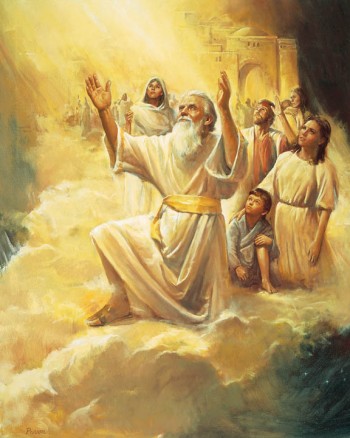
There is a story in the Book of Mormon about a prophet named Lehi and his son Nephi, who also became a prophet. Lehi saw a vision that was later shown to Nephi, who recorded it in the early chapters of the book. In this vision, there was a beautiful tree. Lehi understood the tree’s fruit was highly desirable and eating it will bring great joy. He invited his family to eat the fruit, and the righteous family members did, but the unrighteous chose not to partake.

There is a river running toward the tree, and a straight and narrow path beside it. Along the path is an iron rod. As multitudes of people strove to reach the tree, a mist of darkness arose, making it difficult for people to see how to reach the tree. However, those who held onto the rod—which represents God’s word—reached the tree safely. Those who did not were lost.

Some ignored the rod or got tired of holding on and let go; these fell away and were lost. Others held onto the rod and reached the tree. They tasted it, but were unable somehow to experience the joy others felt upon tasting it. This is because they looked around to see how others were reacting to all this. Those people noted a large and spacious building nearby, filled with people in expensive, elegant clothing. The people in the building were laughing, mocking, and harassing those who ate the fruit. Of course, some were secure enough to trust their own judgment and wisdom and they ignored the mockers, enjoying the full benefits of the fruit, which represented God’s love. Others, though, could not tune out the mockers. These people were embarrassed at being laughed at, and listened to the words of the mockers. They wandered off the path and went back to their former lives or chose new ones, forgetting or ignoring the goal they had once worked to achieve. However, some simply could not just move on. They went to the building and joined the mockers in a life filled with the emptiness of contention and anger.

This is, in many ways, representative of the exmormon world. Mormons feel sorrow for those who leave. They are Mormons because they believe it is the straight and narrow road to Christ. Those who leave are not usually overwhelmingly obsessed with what they left behind, although they often have a sense of what they have lost if they have maintained contact with the Spirit. Most Christians are too busy living lives of Christian service and sharing their own beliefs to worry too much about the teachings of others. Those who abandoned religion completely generally just move on to a secular life.

It is those who hang out in the great and spacious building and devote their lives to mocking and attacking who generally receive the title of exmormon. Rather than focusing on the love and service Christ taught us to live by, they remain trapped in a world of anger and contention. Paul warned:

8 This is a faithful saying, and these things I will that thou affirm constantly, that they which have believed in God might be careful to maintain good works. These things are good and profitable unto men.

  9 But avoid foolish questions, and genealogies, and contentions, and strivings about the law; for they are unprofitable and vain. (See Titus 3)

The Church hopes former members will allow healing to enter into their hearts and longs for their return.

In 1985, at Christmas time, the leaders of the church prepared a special invitation to those who had left the Church. It read in part:

We are aware of some who are inactive, of others who have become critical and are prone to find fault, and of those who have been disfellowshipped or excommunicated because of serious transgressions.

To all such we reach out in love. We are anxious to forgive in the spirit of Him who said: “I, the Lord, will forgive whom I will forgive, but of you it is required to forgive all men.” (D&C 64:10.)

We encourage Church members to forgive those who may have wronged them. To those who have ceased activity and to those who have become critical, we say, “Come back. Come back and feast at the table of the Lord, and taste again the sweet and satisfying fruits of fellowship with the Saints.”

We are confident that many have longed to return, but have felt awkward about doing so. We assure you that you will find open arms to receive you and willing hands to assist you. (See News of the Church,” Ensign, Mar 1986, 82–88.)

  • Share/Bookmark

Are Mormons Polytheists?

Saturday, March 28th, 2009

Question: It seems that Christians are polytheists, worshiping three Gods. Do Mormons believe in one God?

A polytheist is someone who worships multiple gods. Generally, polytheism refers to a group of gods each working independently of one another and often, in the case of hard polytheism, in conflict with one another.

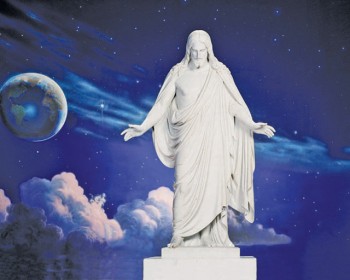
christusMormons believe there are three Gods, but who function as an entirely unified body. Together, they form the Godhead and fulfill the complete mission of God. The Supreme God is God the Father. He is generally the One the Christian Bible refers to when it speaks of God, although in some cases, including in the Book of Genesis, Jesus is referred to as God during the creation of the world. Mormons teach that God’s Son created the earth, under the direction of God the Father. However, it is God the Father that Mormons call God and worship as such. He is the one they consider their Heavenly Father, while Jesus is their brother, the Son of God.

Mormons teach that God the Father is the Father of all things and is male, while the Jewish people teach that God does not have gender. He created the spirits of everyone who ever lived and oversees everything that happens, ruling over Heaven and Earth. We teach that He is very literally our Father, and view Him as a loving, caring Father who watches over His children and wants them to return home to Him.

Jesus is the Messiah, but not the Jewish Moshiach. While many Jewish people believe there will one day be a Messiah, they are watching for a political leader. The Jewish Moshiach is not a god, but a fully mortal human being. Mormons teach that Jesus had a mortal mother, Mary, but that God was very literally His Father. Jesus was His firstborn-the first spirit to be created, and was begotten of the Father. This gave Him a combination of the mortal and the divine, which was essential for him to be able to carry out the task He had undertaken, to live on earth as a mortal, and then to die, but only by His own choice. Mormons teach that no one could take the Messiah’s life from Him; He could only choose to give it.

Mormons teach that the Messiah’s mission was a spiritual one, with hearts won in a spiritual fashion. When He comes the second time, this is when He will rule over the world and be recognized as the Messiah by all, but again, it will be accomplished by spiritual means, not political or military ones.

The third member of the Godhead is the Holy Ghost. The New Testament in the Christian Bible tells of Jesus promising his disciples, in His final days, to send a comforter to them after He was gone. This is the Holy Ghost. This third personage in the Godhead does not have a perfected body of flesh and bone, as do God and Jesus. He is a Spirit. His role is to teach truth to those who are willing to hear it.

Jesus and the Holy Ghost honor God the Father and do only His will. They completely subject their own will for His and give Him the honor for all that happens. This is the meaning of the Christian Bible’s statement that God and Jesus are one. They are entirely unified in every way.

While the Mormons do teach there are three Gods, these are Gods working in perfect harmony, not at cross purposes, to carry out the work of God the Father for His children. It is God the Father who is worshipped as God.

  • Share/Bookmark

What is Confirmation Like for Mormons?

Tuesday, March 24th, 2009

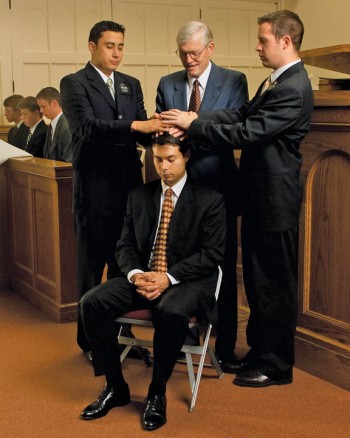
Mormon children can be confirmed members of the church at the age of eight. Converts older than eight are confirmed soon after their baptisms.

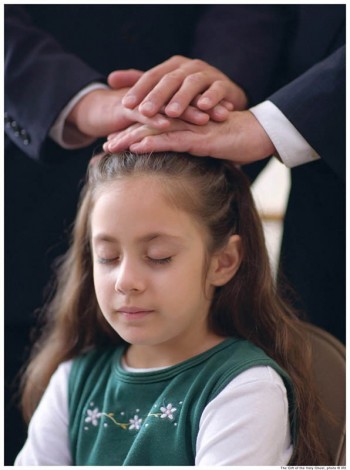
The confirmation is a very simple procedure. The person being confirmed sits in a chair, with arms folded for the prayer that is about to begin. Men who hold the proper level of Mormon priesthood and who have been invited by the person being confirmed, gather around the seated person. They each place one hand on the child’s head, and one on the shoulder of the man next to them. The child will have previously decided who will confirm her. Since all worthy male members of the church of the proper age can hold the priesthood, this is usually the child’s father. If the father doesn’t hold the priesthood or isn’t living, any other priesthood holder can be selected.

The confirmation is done formally, with the priesthood holder simply confirming the child a member of the church in selected language, and then telling the child to receive the gift of the Holy Ghost. The child does not publicly respond to this, but does so in her own heart. Then a special blessing is bestowed on the child. There is not a prescribed method for this. The priesthood holder offers the blessing in whatever words are given to him by God. Often these include words of advice from God or a bit of information about God’s plan for that person. The confirmation concludes in the name of Jesus Christ. Then t

854

he child (or anyone being confirmed) stands and shakes hands with the men who participated, and usually hugs the family members.

After everyone has returned to their seats, a church leader invites the new member to stand and he or she is presented to the congregation as the newest member of that congregation. Members are invited to raise their right hand to demonstrate their welcome and their commitment to supporting the new member in her church membership.

Confirmation is most often done in church the Sunday following the baptism, but is occasionally done right after the baptism.

A convert (anyone who joins the church after his ninth birthday) prepares for this moment by meeting with missionaries to learn about the church. They are expected to make an informed decision. While they won’t know everything at baptism, they need to know how to pray to learn God’s will concerning this choice, and they need to have a basic understanding of the church’s teachings. They are taught about God, Jesus Christ, the scriptures, and a few basic principles of the religion. They must also attend church several times to find out what it is like.

A child who joins will have been preparing for this moment from birth, or since his parents became members of the church. They learn gradually more complex gospel principles in formal church instruction on Sundays beginning at the age of eighteen months. They are also taught at home. Families are encouraged to hold a family home evening each Monday, in which family members teach each other their religion. They also have family prayer and daily scripture study together. By the time the child is ready to be baptized, he has a firm foundation in his religion and knows how to pray.

Even at the age of eight, children are expected to pray and to ask God if they should join the church. They, like adult converts, must demonstrate a basic understanding of their religion and to have a testimony of their own.

  • Share/Bookmark

How do I know The Church of Jesus Christ of Latter-day Saints is true?

Monday, June 30th, 2008

Personal Response by Todd

“I know the Church is true…” I’ve heard the phrase many times growing up in the Mormon Church. Thousands of members of the Church say those words each day and millions each year. When I was in high school I started to doubt. I didn’t remember ever having spiritual experiences like so many talked about. It was hard to believe that my family and friends were really experiencing what they claimed. I grew up in South East Texas where the Mormon Church was a minority. I remember wanting so desperately to fit in, to be just one of the guys. However, one day as I was with a group of friends, I felt a powerful impression to befriend another kid at school who no one talked with. It kept pushing and pushing me. Of course I fought back. I’ve since come to recognize that impression to be the Spirit “which inviteth to do good…, and to persuade to believe in Jesus Christ…wherefore ye may know with a perfect knowledge it is of God” (Moroni 7:16).

382

That was the first time I felt something different. Simple I know, but it was the grand beginning of a witness. I will never forget the feeling of something beyond me encouraging me to ignore the attitudes of worldliness and seek for the world of a better. I knew at the very least that God was out there. Over the years I started to see God’s hand in my life. The principles of the gospel began to make more sense and I became addicted to learning and absorbing the doctrines taught over the pulpit and in the scriptures. My life seemed perfect. I found that I was much happier. Life’s burdens seemed lighter as I was trying to live like Jesus Christ.

  • Share/Bookmark

How did serving a Mormon mission bless me and those I served?

Friday, May 2nd, 2008

Personal Response by Rachel
I have summed up the most significant lesson I learned on my mission in six words: “Come unto Christ and be happy.” This phrase has become a personal motto for the rest of my life. Each morning of my mission we had an hour to do personal study of the scriptures and Preach My Gospel. The more I studied the words of Jesus Christ through His ancient and modern prophets and apostles, the more I came to love Him and believe in Him. My growing belief and faith in Christ led me to follow His teachings, develop Christlike attributes, and testify of Jesus Christ’s restored gospel. As I obeyed the commandments of the gospel and became more like Christ, I felt the Holy Ghost’s influence more abundantly in my life. I felt the fruits of the Holy Ghost, which include “love, joy, peace, longsuffering, gentleness, goodness, faith, Meekness, temperance” (Galatians 5:22-23). I learned that “If ye know these things, happy are ye if ye do them” (John 13:17). Every day of my mission was an opportunity to do the things Jesus Christ has asked of us. When I chose to follow Christ, I was blessed with happiness, joy, love, and peace. My dad has often told me that he can always tell when I am happy and acting in a way that is pleasing to the Savior. “You have a sparkle in your eyes,” my dad has said. “So, I know that you are on the right path.”

  • Share/Bookmark