Posts Tagged ‘about Mormons’

Christ’s Church (“Mormons”): Helping out a Friend

Monday, April 1st, 2013

The following article was written by Ethan G., a student at Brigham Young University

BYU (Brigham Young University) is operated by The Church of Jesus Christ of Latter-day Saints, often mistakenly called the “Mormon Church.”  As part of their undergraduate coursework, BYU students take multiple semesters of spiritually uplifting, stimulating religion classes.

In this series (see below), students enrolled in scripture study classes have shared their thoughts, insights, and reflections on the Book of Mormon in the form of letters to someone they know. We invite you to take a look at their epiphanies and discoveries as they delve into the scriptures.

In publishing these, we fulfill their desire to speak to all of us of the relevance, power and beauty of the Book of Mormon, a second witness of Jesus Christ and complement to the Bible. The Book of Mormon includes the religious history of a group of Israelites who settled in ancient America.  (The names they use are those of prophets who taught the Book of Mormon peoples to look forward to the coming of Christ—Nephi, Lehi, Alma, Helaman, and other unfamiliar names.  We hope those names will become more familiar to you as you read their inspiring words and feel the relevance and divinity of their messages through these letters.)

Let us know if you’d like to receive your own digital copy of the Book of Mormon, and/or if these messages encourage and assist you spiritually as well.


One of my best friends was struggling a while ago with an addiction. He came to me in confidence mostly because I felt like something was wrong with him and I invited him over to find out. He then explained to me everything he was dealing with and and I was able to share with him a lot of my past experiences that related to his struggles and helped him to have the courage to talk to his Bishop, a local Church leader, and get his life sorted out.

Now he is free from the addiction and his life is going amazing right now. This past week I got a call from this friend, and he shared with me an experience he had just had. He reminded me of all that I had helped him with and how my experience really helped him with all that he was struggling with. He then told me how one of his good friends was having a hard time with the same addiction. He felt like something was wrong and asked his friend to meet up with him. He then questioned him as I did to find out what was wrong and his friend explained everything. He then told me how amazing it was to be able to share of his own experience and his hardships to help out a good friend.

So the lesson came from reading in Helaman 10:4-5, in the Book of Mormon:

“Blessed art thou, Nephi, for those things which thou hast done; for I have beheld how thou hast with unwearyingness declared the word, which I have given unto thee, unto this people. And thou hast not feared them, and hast not sought thine own life, but hast sought my will, and to keep my commandments. And now, because thou hast done this with such unwearyingness, behold, I will bless thee forever; and I will make thee mighty in word and in deed, in faith and in works; yea, even that all things shall be done unto thee according to thy word, for thou shalt not ask that which is contrary to my will.”

I shared with my friend these verses and how he and I were blessed to be instruments in God’s hands. I was so happy that he was able to feel the joy of being on the other side of the coin. We then talked about how we need to seek to do Heavenly Father’s will because when we both prayed for guidance to help our friends we have been blessed with opportunities to do so.

So this lesson was for both him and me, that as we seek the will of Heavenly Father we can learn how to ask according to his will and be instruments in his hands as was Nephi. So we both set goals together and doing all we can to be worthy for the Spirit and clean as Nephi was clean. We both felt strongly that we would be able to be great influences in the lives of those who are in need. We felt that this would be a great challenge but a great blessing for those around us as we seek the will of the Father.

Want to learn more about Mormon beliefs?  Check out Mormon.org

Request a free Book of Mormon here

Mormons Honored for Portrayal of People With Disabilities

Friday, March 8th, 2013

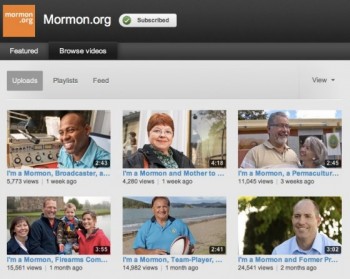
Many people have seen the popular “I’m a Mormon” campaign, which outlines the lives of ordinary and diverse members of The Church of Jesus Christ of Latter-day Saints. What you may not know, though, is that more than 120,000 of those profiles are of people with disabilities. Some are written by the members themselves. Others are unscripted videos. Recently, The American Association of People with Disabilities recognized the Church for its outstanding portrayal of people with disabilities in mass media. AAPD President and CEO Mark Perriello said, “They tell the disability experience in a way that is real, no apologies, and it’s absolutely astounding.” He called them a powerful force for changing public perceptions of people with disabilities.

Mormons volunteer more than other Americans.One video includes the amusing story of a man with just one leg. Most of his young martial arts students don’t know that one of his legs is artificial so when a child yanked it off by mistake, the class—including the waiting mothers—were thrown into chaos of tears and screaming. This man, Tim Hurst is also a marathon runner.

Ingrid Maldonado, a Guatemalan amputee, is a college student and also works for the government, helping people who can’t read or write with applications. She lost her legs a little at a time after catching on fire and had a series of surgeries from ages two to twelve. When she gets depressed, she remembers that others suffer far more and that Jesus Christ, though suffering great trials, went through life essentially happy and that she can, too. She considers herself a person with no limits.

Jarom Frye survived cancer as a teenager but lost a leg when he chose amputation over the other options. He is a serious athlete—he climbs rocks, water skis, snow skis, and rides a mountain bike. He couldn’t find just the leg he needed…so he built his own. Today he creates products to help other people with disabilities to carry out their own dreams. He decided as a teenager to ignore the experts who told him he couldn’t continue his athletic life and he has proven them all wrong. He is a husband, a father, an innovator, and of course, a Mormon.

The Mormons have a wide range of resources for people with disabilities. Children with special needs are integrated into their regular classrooms at church, both for their own advantage and for the benefit of their classmates. Materials for church members are available in braille, audio, captioned video, American Sign Language and large print. A website about disabilities for members with special needs, parents, teachers, and leaders is available in ten languages. Buildings are accessible to those who need accessibility. When a child has a special need, the teachers and leaders are taught how to meet those needs and when necessary, an aid is provided. The humanitarian services program offers a wheelchair program and a vision program for people who are not Mormon in many countries.

When visiting a Mormon ward (congregation), you might find a sign language interpreter in the worship service, an aid for an autistic child in the Primary children’s organization, a blind toddler nursery leader, or a boy in a wheelchair passing the sacrament (communion). Most Mormons have volunteer positions referred to as callings, and people with disabilities serve in most of those positions, including leadership positions. Sometimes leaders become very creative in finding meaningful work for someone who has intense special needs. One congregation appointed a young adult with an intellectual disability to ring the bells each week signifying the end of class—a calling that required her to learn to tell time first. Another built a special tool to help a teenage boy pass the sacrament effectively.

In one congregation, a teenager with autism was unable to earn her Personal Progress award, which required a challenging series of accomplishments. The girl’s church classmates decided to earn it for her. Each girl completed one part of her award in addition to doing that part for herself. When they had all finished, she received her award as a gift from the other teenagers.

A thirteen-year-old boy named Spencer, featured in the video below, was chosen as the youth leader for his church class. He was given a responsibility to look after the needs of all the other boys in his class. One boy was named Dayton. Dayton has cerebral palsy and can only communicate through blinking. Spencer is an athlete who runs triathlons and he wanted to give Dayton opportunities he might never have. He asked Dayton if he’d like to enter a triathlon with Spencer and Dayton did. It took some planning, but they figured out how to do it. Spencer swam and biked pulling Dayton behind him in a boat and cart and then on a specially made bike. Spencer was exhausted, but finished the race happily. Each boy also passes the sacrament with Dayton so he can do what the other boys do—they push his chair while carrying the sacrament on a tray on his chair. This is the sort of training young Mormons receive in their church classes by caring association with those who have special needs and this impacts how they will interact the rest of their lives.

Mormon Church: Beware of Pride

Wednesday, December 19th, 2012

We have all been caught doing something we shouldn’t. Something that makes us ashamed to have out in the open, even if we did not know the gravity of its effects on us and those around us. As a member of The Church of Jesus Christ of Latter-day Saints I have studied the Book of Mormon and found many examples of straying away from what is known to be true.

In the first two chapters of the book of the Ancient American prophet Jacob, he discusses the pride and lust that the Nephite people developed several years after the death of the second recorded prophet of the Book of Mormon, Nephi. Jacob describes the downward spiral of their morals (Jacob 1:15):

Book of Mormon

The Book of Mormon warns of the dangers of pride.

And now it came to pass that the people of Nephi, under the reign of the second king, began to grow hard in their hearts, and indulge themselves somewhat in wicked practices, such as like unto David of old desiring many wives and concubines, and also Solomon, his son.”

Based upon this verse of scripture, the Nephite people were losing the vision of the gospel that their previous prophet, and Jacob’s elder brother, Nephi, laid as a foundation for them. We can also see from this scripture that these people, who had migrated from the Middle East to what we know today as the “Americas,” had an extensive knowledge of what we have today as the Old Testament. If these people had all this scripture, as well as modern prophets to lead and guide them down the paths of righteousness, then why would they ever fall away from the truth?

The answer is simple: when we have pride, we stray from the will of the Lord.

In the case of the Nephites at Jacob’s time, the people became so out of hand that he had to bring all of the people together, with wives and children present, to tell them of the gravity of the choices that they were making. Let us never get to the point of a “sit down” to figure out that our choices are hurting others. Take a constant personal inventory and make sure that your life and your relationships with others are going the way that you want them to.

When we become prideful and enveloped in our own wants and desires, we put the will of the Lord and spiritual leaders aside in favor of our own. This is what occurred to the people of Nephi at this time. They became so involved in their want for earthly riches and sexual fulfillment to even care about their spiritual progression. We, as a people, need to take the necessary precautions in our lives so that we do not become so involved with temporal wants and needs to not focus on what the Lord wants us to do with our lives.

Many people believe that when you conform your life to the will of the Lord that your life will be boring and “overly religious.” I am here to tell you that that is not the case at all. Because no human being on this earth is perfect it is impossible to be 100% in line with the Lord’s will 100% of the time. However, I know that if we make a concerted effort to find more about the Lord’s will and ask Him with real intent through prayer, that we will receive answers about where to lead our lives.

This article was written by Keegan M., a student at Brigham Young University and a member of The Church of Jesus Christ of Latter-day Saints.

Additional Resources

What do Mormons believe?

About Mormons


Mormon Church: Joy of the Gospel

Wednesday, December 19th, 2012

I am a member of the Church of Jesus Christ of Latter-day Saints (sometimes mistakenly called the “Mormon Church”), and a freshman at BYU. I am currently taking a religion class on the Book of Mormon. Last week we talked about the gospel of Jesus Christ. God has given us specific steps that we need to perform in order to return to live with Him again. We learned in class that these steps were symbolized in the ancient tabernacle that the Israelites carried in the wilderness during the Exodus. Consequently, we looked at this tabernacle to learn about the gospel.

Mormon Temple

Like the Tabernacle, Mormon temples today are full of symbols of the gospel.

The tabernacle was split into three sections: an outside courtyard, an inner room, and the Holy of Holies. Each of these areas was successively more holy than the last. These areas can then symbolize our journey to become better people and return to live with God. We move from a life of sin, being unholy and separated from God, to higher and higher levels of holiness as we repent and change our lives; this process culminates in our eventual entrance into the most holy of all places, heaven, symbolized in the tabernacle as the Holy of Holies.

The rest of the tabernacle was filled with symbols to teach the children of Israel about the gospel of Jesus Christ. Each of the steps of the gospel–faith, repentance, baptism, receiving the Holy Ghost, and enduring to the end–were symbolized in some part of the tabernacle. For example, repentance was symbolized in the altar that stood in the outside courtyard. The altar symbolized the Israelites’ need to sacrifice those things that would keep them from coming unto God–their sins. It also reminded them of the sacrifice that Christ would make for them, that would allow them to repent of their sins.

The next object in the courtyard was the laver, a basin the Israelites used to wash themselves in preparation to enter the next room in the tabernacle.This represented the next step in the Gospel–baptism. The physical washing at the laver was symbolic of the spiritual cleansing of baptism. After the Israelites had washed themselves using the laver they could then enter the next room, which was holier than the outside courtyard.

In my church, The Church of Jesus Christ of Latter-day Saints, baptism is the ordinance by which one becomes a member. When we are baptized we promise to live a different lifestyle than the rest of the world; we agree to follow God’s commandments, even if it means we will have to sacrifice our own personal desires at times; we promise to abstain from alcohol, attend church every Sunday, be honest, avoid vulgar media, obey a strict law of morality, serve others and, in general, live a virtuous and moral lifestyle. Through baptism then, we enter into a life that is separate, to some degree, from the world.

The words of one of the prophets of the Book of Mormon, Nephi, further help to illustrate this idea. He taught, “The gate by which ye should enter is repentance and baptism by water; and then cometh a remission of your sins by fire and by the Holy Ghost. And then are ye in this strait and narrow path which leads to eternal life” (2 Nephi 31:17-18). A consecrated life– one in which we sacrifice our personal desires and agree to obey God–is this path “that leads to eternal life.” Baptism is the way we make these promises with God and begin on the path, and faithfully fulfilling these promises is how we stay on this path.  Eventually, a diligent adherence to these promises will allow us to reach that heaven symbolized by the Holy of Holies.

What I found amazing, though, was that the blessings associated with living this law are not entirely postponed until that time. When the Israelites sacrificed at the altar and washed themselves in the laver they could move from the outer courtyard to the inner holier room. Likewise, if we repent and make promises with God through baptism we enter into a higher, holier lifestyle, and we can receive greater happiness and joy; we can receive a degree of the joy of heaven. We cannot enter into heaven until the next life, but we can, if we keep the standards God gives, feel some of that joy and happiness now. The path that Nephi talked about does not just lead to heaven, it also provides us with joy as we follow it. I have seen the happiness that keeping these baptismal promises has brought to me and to those around me. I know that following the standards that God has set allows us to obtain more happiness in our lives–happiness we cannot receive through any other way. At times it is hard to keep these standards and it requires a lot of sacrifice, but it is worth it.

This article was written by Zach S., a freshman at Brigham Young University and a member of The Church of Jesus Christ of Latter-day Saints. He is interested in math and science and enjoys playing soccer and ultimate Frisbee.

Additional Resources

What do Mormons believe?

History of Mormonism


Mormon Church: Contradictory Beliefs?

Tuesday, December 11th, 2012

As a sophomore studying physics at Brigham Young University, I have a different view on the world than a lot of youth my age. Many people wonder how I can reconcile such strong religious beliefs with such secular logical theory. But I have a strong testimony of both. To me faith fortifies the logical, and my secular knowledge of physics and the mechanics of the universe broadens my understanding of God. If I was limited to only one or the other, I would in fact find myself confined and restricted in understanding.

mormon education

Learning more about the world around us can help increase our faith in God.

For example, throughout scripture God commonly uses the concept of light as His preferred metaphor for Himself. To many this would merely be an accepted condition and they would move on to read the rest of the verse, but to me, as I study light in my physics classes at BYU, I understand the great meaning that can be drawn from this name alone. For example, light is used to not only expel darkness and bring warmth, but it is also the byproduct of electrons bumping up an energy level and thus emitting a photon.

This can be compared to God’s presence becoming more and more evident in our life as we ascend to higher spiritual levels. In addition, light is the only material that is truly constant in the universe—being the basis of all the equations and theories that we have,—just as God is the only true and unchangeable constant in the universe, the only constant upon which if we build we can never ever fall. And finally, light is the only material that is both a particle and a wave, and whose behavior varies upon whether or not we are observing it (double-slit experiment). A single photon will inexplicably behave as a wave if unobserved, but once placed under the scrutiny of the human eye it will behave as it should, or rather as a particle. Similarly, God does not always act the way we expect, seeing as we are observing a celestial and infinite subject through finite mortal eyes, as He says “for my thoughts are not your thoughts, neither are your ways my ways, saith the Lord.” (Isaiah 55:8).

This week for my religion class at BYU I was reading in the Book of Mormon from the book of the early American Prophet Jacob who lived several hundred years before the birth of Christ. In the fourth chapter he warns against those who “despise the words of plainness and killed the prophets, and sought for things that they could not understand” (Jacob 4:14). It goes on to tell how because of their pride God took away that which was easy to understand and gave them that which was difficult, for that is what they desired. And because of this they stumbled. Or in other words they fell away from the truth and became lost and confused in their own ways. Although I appreciate and love physics, and it does open my mind to many interesting insights, such as that with light, I need to slow myself down sometimes. For I have found that the most precious and wonderful concepts I gain are from the sweet and simple basic principles taught by the Savior, not the deep doctrine I sometimes aspire after. And just like a baby must begin with milk and work up to meat, so it is with me. And sometimes I need to remember to bite off only that which I can chew, and by doing so, I always gain the most.

This article was written by Rachel G., a student studying physics at Brigham Young University and a member of The Church of Jesus Christ of Latter-day Saints.

Additional Resources

Mormon beliefs

History of Mormonism

Mormon Church: Our Power Over Our Destinies

Tuesday, December 11th, 2012

Hey there, my name is Stuart and I’m a college student here at BYU. I’m hoping to someday become a surgeon, but I still have a lot of school left ahead. I’m nearly 22 and a member of The Church of Jesus Christ of Latter-day Saints (mistakenly called The Mormon Church). We’re known that way for a book of scripture called the Book of Mormon, which is very much like the Bible in that it teaches of Christ and was written by prophets, but it is different because it was written by ancient prophets in America. One of the first of these was a man named Nephi, a very righteous man who lived roughly around 600 BC. He took great care to teach his people the law and the commandments and of the Savior who was to come. To do this, many times he read to them words of previous prophets and helped them understand and apply them. That is also the way we should use scripture, trying to make it personal. One of his favorite prophets to quote was Isaiah. Nephi dedicates several chapters to sharing some of Isaiah’s teaching that he used. This last week I read some of those chapters and some things jumped out at me, especially in chapter 24 of 2 Nephi. In this chapter Nephi is quoting what we know today as Isaiah 14 and it speaks about the devil. Usually that’s something people frown upon, thinking that it’s not even good to talk about him, but in reality it depends on what’s being said and why. Isaiah in this part is taunting the devil and at the same time teaching us a valuable lesson. He speaks of the last days, how the Lord will be victorious and reward His covenant people. He speaks of how the world will rejoice, that it will break forth in singing at the downfall of the tyrant. The next verses have always caused me to ponder, they read:

10 All they shall speak and say unto thee: Art thou also become weak as we? Art thou become like unto us?

11 Thy pomp is brought down to the grave; the noise of thy viols is not heard; the worm is spread under thee, and the worms cover thee.

12 How art thou fallen from heaven, O Lucifer, son of the morning! Art thou cut down to the ground, which did weaken the nations!

13 For thou hast said in thy heart: I will ascend into heaven, I will exalt my throne above the stars of God; I will sit also upon the mount of the congregation, in the sides of the north;

14 I will ascend above the heights of the clouds; I will be like the Most High.

15 Yet thou shalt be brought down to hell, to the sides of the pit.

16 They that see thee shall narrowly look upon thee, and shall consider thee, and shall say: Is this the man that made the earth to tremble, that did shake kingdoms?

17 And made the world as a wilderness, and destroyed the cities thereof, and opened not the house of his prisoners?

Mormon Jesus Christ

Through Christ we can overcome everything Satan throws at us.

It’s so intriguing to me. Isaiah talks about all the things that Lucifer (the devil) is known for. What great power and potential he had. Son of the Morning! He was a mighty one before God at one point, but his pride filled him with rage. With his cunning and rage he shook kingdoms and destroyed cities. Yet, for all that, when the time comes he will be subject to justice because Jesus Christ took everything he could throw at him and overcame it. Now we know that Christ is the King of Kings and Lord of Lords, Master of All, the Great I AM. It doesn’t surprise us that Christ will be victorious over the adversary. What does strike me most is the reaction that we will have. Verses 16-17 we’re told that we will see Satan there, I picture him huddled dejectedly in chains, and when we see him we will say: “Really? This is the guy? The one responsible for so many terrible tragedies and so much hate and destruction? This guy right here?” We won’t believe our eyes, he will seems so impotent. To me that’s so fascinating. In our lives right now we think of the devil as if he has so much power to come and destroy our world, like some huge dragon. The truth is he only has as much power as we give him! He gets his way and causes so much devastation by spreading lies with a silken tongue. We have the choice whom we will allow to direct us, however, and if we give in to temptation than we allow Satan greater power and influence over us. But we don’t have to! Christ, our Savior, will be victorious and with Him we can completely overcome the adversary! I love to tell people this, especially those struggling with addiction or similar things because you realize the winning team is recruiting and desperately wants us on their side. Jesus is the answer, He will be the victor and wants to help us to overcome as well. All we have to do is believe that and live His teachings, and when the time comes we will look at Satan with the satisfaction that with the Lord’s help we did not fall victim to him.

I know that Christ is our Savior and we can join with Him by learning His words and living them. The Book of Mormon: Another Testament of Jesus Christ, teaches plainly and completely what we must do and we can draw nearer to God through living its teachings than in any other way.

This article was written by Stuart M., a student studying pre-med at Brigham Young University and a member of The Church of Jesus Christ of Latter-day Saints. Stuart is from Las Vegas and enjoys playing sports, studying, and listening to music.

Additional Resources

What do Mormons believe?

Mormon history

Mormon Church: “Ye Must Pray Always”

Tuesday, December 11th, 2012

I’m in my second month as a freshman here at Brigham Young University and I couldn’t be more grateful for my required Book of Mormon class. The fact that twice a week I get to learn more about scriptures in an academic setting always amazes me! Both our class lectures and my out-of-class readings help me keep my priorities straight and remind me of my Heavenly Father’s love. This last week I was especially touched by a passage spoken by the ancient American prophet Nephi as he was nearing the end of his life. This is found in 2 Nephi 32:9.

“But behold, I say unto you that ye must pray always, and not faint; that ye must not perform any thing unto the Lord save in the first place ye shall pray unto the Father in the name of Christ, that he will consecrate thy performance unto thee, that thy performance may be for the welfare of thy soul.”

Mormon Prayer

The Lord wants us to come to Him so He can help us make decisions.

Nephi is reminding those who read his words of a powerful principle. If we are trying to do something “unto the Lord” it is imperative that we pray to Heavenly Father about it. This way He will be able to make our experience something that will enable us to obtain our goal of eternal life. Perhaps the strongest word employed by the prophet Nephi is anything. There should not be anything that we are doing which is not “unto the Lord,” and thus if we take the proper steps there should not be anything in our lives which is not being consecrated by the Lord for our eternal welfare. School, work, relationships, service—these are all facets of our lives where we can obtain incredible support from our Heavenly Father.

A month ago I began volunteering at the Boys & Girls Club here in Provo. Each Tuesday I spend around two hours there helping underprivileged children ages 5 to 7. We work on homework, have snack time, play outside, and do artwork. Walking the mile to the building on my first week as a volunteer I said a silent prayer to my Heavenly Father asking that I might be able to positively affect the lives of the children I was about to meet. As I was there, an image came into my mind of the beautiful painting by Carl Bloch of the Savior at the waters of Bethesda where He ministered one by one to those who were sick and afflicted. On a much smaller scale I was also ministering one by one, as I helped children who were lonely, poor, or sad. Afterward, as I walked back to my apartment I realized that this service had left me feeling closer to my Heavenly Father more than almost anything else I have done since coming to Brigham Young University. Since that time I have tried even harder to make this service a matter of prayer with Heavenly Father, and I have felt him truly consecrate my performance; my weekly visit at the Boys & Girls Club has become necessary for the welfare of my soul.

I’m thankful for the understanding I have of my Heavenly Father, an understanding that comes through my membership in The Church of Jesus Christ of Latter-day Saints. Through reading scriptures like the one mentioned above I have realized that the Savior actually cares about every aspect of my life and if I will but pray to Him I can receive support in all of my endeavors.

This article was written by Katie S., a student and Brigham Young University and a member of The Church of Jesus Christ of Latter-day Saints.

Additional Resources

Mormon beliefs

Meet Mormon missionaries

Mormon Church: Value of the Scriptures

Monday, December 10th, 2012

How do we treat our scriptures? Is there a dusty old Bible sitting in the corner or on a forgotten shelf? Or is it well-worn from much use? Too often, people underestimate the value of the things written in scripture.

Jacob, an ancient prophet in the Book of Mormon (a work of scripture used by The Church of Jesus Christ of Latter-day Saints, sometimes mistakenly called the “Mormon Church”), teaches about the commandment his older brother Nephi gave to him with regards to keeping records. Nephi, who was the prophet before Jacob, gave him two sets of plates to write on: the large plates and the small plates. The large plates, were to contain the history of Nephi’s people—the records of their wars, and kings, and dealings with others. The smaller plates, which became part of the Book of Mormon, were to be kept for spiritual matters. Jacob says, “And if there were preaching which was sacred, or revelation which was great, or prophesying, that I should engraven the heads of them upon these plates, and touch upon them as much as it were possible, for Christ’s sake, and for the sake of our people” (Jacob 1:4).

Mormon Scriptures Study

The scriptures contain the words of the prophets of old, many of whom wrote about our day.

There are two interesting things in this verse: first, that Jacob (and subsequent prophets) should “touch upon them as much as it were possible,” and second, that it was for the people’s sake. Jacob was commanded to write as much as possible about spiritual things that happened—revelations received or prophesying. This shows us the importance of the things that we read in the scriptures. Both the Book of Mormon and the Bible contain sacred words—lessons and teachings of prophets. If Jacob was commanded to write the things he thought were most spiritually precious and valuable, what does that say to us about how we should treat the scriptures? We should read them, study them, and know them. Joshua 1:8, speaking about the scriptures, says, “…Thou shalt meditate therein day and night, that thou mayest observe to do according to all that is written therein.” The scriptures can be of much value in our lives. As we learn and apply the principles found in them, we can become better people and learn to be more like God.

The second thing is that it is for the people’s sake. However, it does not apply to just Nephi’s people. It applies to all people. The scriptures weren’t written simply for entertainment value. Why would anyone write sacred things down unless the lessons could be applied to better a person’s nature? The scriptures are for us. Some people argue that they are old-fashioned, out of date, and out of touch with the modern world. However, a study of scriptures and the application of principles therein continue, even in this modern world, to improve someone. By following the teachings, we become more like God, and therefore are better people.

The scriptures are a great help to me. I know that I can find words of comfort in them when I am feeling down. I can also find lessons that will make me a better person. I come closer to God and feel His Spirit when I read the words of His prophets. If God said something, wouldn’t you want to know what it was? Turn to the scriptures. They are the words of God.

This article was written by Beth W., a student at Brigham Young University and a member of The Church of Jesus Christ of Latter-day Saints. Beth wants to go into nursing and enjoys playing piano, swimming, reading, and eating chocolate.

Additional Resources

What do Mormons believe?

History of Mormonism

Mormon Church: Serving Others

Monday, December 10th, 2012

Members of The Church of Jesus Christ of Latter-day Saints (sometimes mistakenly called the “Mormon Church”) are firm believers in helping the poor and needy. We believe that it is what Christ would do, and so we should follow His example by helping others. We learn principles like this from the Book of Mormon, a book of holy scriptures similar to the Bible, because it talks about it in there. The Book of Mormon is about the God’s people who lived on the American continent. The Book of Mormon tells and preaches of Christ; Christ even appears to the people in that land after He was resurrected.

One of the more prominent parts of the Book of Mormon that talks of helping the poor among us is from the book of Jacob. Jacob was a prophet among the nation of the Nephites (the “father” of their nation was Nephi, who left Jerusalem in the year 600 BC, 13 years before the city was destroyed by the Babylonians) who was commanded to tell the people to repent of their ways and return to God. One of the sins that the Nephites were struggling with was pride. Many of them believe that because they had more money and riches compared to others, that they were better than the poor. Jacob tells them that this is a false assumption, and that everyone is equal to each other. He tells them that if they do seek for riches, that the riches should be used “for the intent to do good—to clothe the naked, and to feed the hungry, and to liberate the captive, and administer relief to the sick and afflicted” (Jacob 2:19).

Mormon Tithing

By paying tithing and fast offerings Church members help provide for the Church’s needs and for the poor and needy.

As members of the Church today we try to do this. One of the ways we do this is a “fast offering” fund. A fast offering fund is where members of the Church, or anyone who wants to participate, donate money to the cause of helping others that are going through financial struggles. By doing this, those who need the money will receive it. What is amazing is 100% of the money donated is given to the cause of those in need. Now-a-days, many charities only give a portion of the money donated to the actual cause. With our Fast Offerings, 100%, and no less, goes to those who need it. We also have what is called tithing, where members give 10% of all their income to the effort to help build our Church. It is used to build more church buildings, and things of that nature. None of the money donated ever is given to our clergymen; they do not have salaries at all. They do not get paid a penny for all the time and effort they put into helping out the Church.

My parents, after each paycheck they get, pay both tithing and fast offering. Because of this economy, everyone has had a hard time, my family included. We moved in the summer of 2007, around when the house market started to fall. Over 5 years later, we have yet to sell our old house, making it sometimes hard to pay bills for two houses. No matter how tight money got, we would always pay 10% for tithing, and what we could for fast offering. Because of this, we have ALWAYS been able to pay each monthly bill. It is because God blessed us that we have been able to get through these five years. I know that if we use our money for the right purposes, God will bless us, and help us out. I know this Church is true. I know that Jesus is the Christ. I know that if we choose to do the right, we will be blessed.

This article was written by Laura R., a student at Brigham Young University and a member of The Church of Jesus Christ of Latter-day Saints.

Additional Resources

Learn about Mormons

Meet Mormon missionaries

Mormon Church: Choosing a Path

Monday, December 10th, 2012

I’m not sure if this is just a metaphor that Mormons (members of The Church of Jesus Christ of Latter-day Saints, sometimes mistakenly called the “Mormon Church”) have used, but I’ve been taught since I was a little child that there are two paths available to follow when it comes to our commitment to church. First is the straight and narrow path that leads us back to God. The reason why it is described as straight is because He tells us pretty explicitly what He wants us to do and how to do it so that we could return back to Him. We can also see Him the entire time we’re progressing, which we wouldn’t be able to do if the path was winding. This first path is also described as narrow though, because of how specific He is. There is not a lot of leeway when it comes to God’s commandments. The second path that we can take is the wide and winding path that leads us away from Him. This path is wide because there are an infinite number of ways that you can deviate from the Lord’s will. Imagine stepping stones spanning a wide, rushing river, or better yet, think of the movie Mulan. You know, that part when they’re singing “I’ll Make a Man out of You” and they cross the river on tree stumps? I like that idea better because you are further away from the rushing water as opposed to how you’d be right on top of it if you were on stepping stones. Anyway, the stones/tree stumps are like the commandments of God and the idea of a wide, rushing river represents all the ways that you could not follow God’s commands. There are so many different ways to do what isn’t necessarily right because doing what is right is so specific.

Book of Mormon

The Book of Mormon helps us stay on the path that leads to our Heavenly Father.

Now, most people think that once you reach that straight and narrow path, you’re set for life. This is where my Book of Mormon class at Brigham Young University steps into the picture. While reading the assigned reading in the book of Second Nephi, I came across the following verses:

And now my beloved brethren, after ye have gotten into this strait and narrow path, I would ask if all is done? Behold, I say into you, Nay; for ye have not come this far save it were by the word of Christ with unshaken faith in him, relying wholly upon the merits of him who is mighty to save.

Wherefore, ye must press forward with a steadfastness in Christ, having a perfect brightness of hope, and a love of God and of all men. Wherefore, if ye shall press forward, feasting upon the word of Christ and endure to the end, behold, this saith the Father: Ye shall have eternal life (2 Nephi 31:19-20).

These verses shows us that we still need to put forth all the effort that we did to get on the path in order to stay on it. We still need to be steadfast, have hope, love God and man, immerse ourselves in the scriptures (as well as whatever other sources of His Word that we have), and maybe most important, endure to the end. We cannot become lazy once we reached our goal because if we are not moving forward, we are moving back. There is no way to stay in one state of being. We are always progressing or digressing. This is something that I need to remember because I am guilty of becoming lazy. I will do well for a while and read my scriptures with a sincere desire to learn and I’ll pray with real intent, but then I get caught in a false sense security and develop a sense of apathy towards my spiritual growth. I encourage you as well as myself to remember to always continue onward on the straight and narrow path towards our Heavenly Father. I say these things in the name of Jesus Christ, Amen.

This article was written by Anna R., a student at Brigham Young University and a member of The Church of Jesus Christ of Latter-day Saints. Anna is looking to major in vocal performance or communication disorders to order to become a speech pathologist. 

Additional Resources

What do Mormons believe?

Meet Mormon missionaries