The Bible Archive
The Church of Jesus Christ of Latter-day Saints, whose members are informally known as Mormons, has released a new edition of the Bible in Spanish. This edition is based on the public domain edition of the one hundred year old Reina-Valera translation of the Bible. Minor edits were made to update grammar and to make more clear words that have taken on new meanings in the past century and alterations were made for words that have developed offensive meanings. This edition contains footnotes and headings pertaining to LDS doctrine and includes cross-references to LDS scriptures and resources. This improves its usefulness as a study tool for Mormons, and also aids non-Mormons who wish to study the Bible as the Mormons see it. It also allows church classes to function more effectively since previously each member had a different translation, making Sunday School classes on the Bible very complicated.
The entire process took about five years, due to the sacred nature of the work and the need... Read the rest of this entry »
701
This question is often asked by evangelicals, and is, in general, a misunderstanding of the Mormon teachings on what happens after death and how we control that.
Many evangelicals teach that a person gets to heaven by being “saved.” This involves the act of accepting Jesus Christ as their personal Savior. At the same time, they teach that acts cannot get you into Heaven. The Mormons also believe that a person must accept Jesus Christ as His Savior in order to return to God’s presence after death. Both groups agree that at least one act is required of all of us in order to be with God.
The confusion over the number of acts required to be saved comes from the differences in terminology used by Mormons. Mormons believe everyone is saved through the atonement of Jesus Christ, even if they never accept Jesus Christ as their Savior. However, grace and eternal life, to a Mormon, are not the same thing. To understand this complex issue, let’s look at several essential points.
Read More →
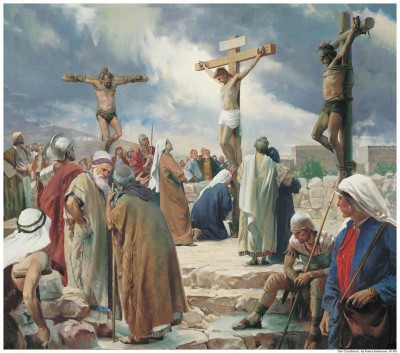
Stations of the Cross is a Catholic tradition that grew out of a desire to replicate pilgrimages to Jerusalem. Today, they help Catholics remember the final days of the life of Jesus Christ as they move through a series of wooden crosses that have been blessed by a person with the authority to do so and pray. Some consider it reparation for the suffering and loneliness of the Savior’s personal Via Dolorosa. Pope Pius XI considered it an obligation for Catholics and John Paul II praised those who make an effort to stand by the endless crosses the Savior endures even today through abuse and mistreatment from those who do not honor the Sacrifices He made for them.
298
Although Mormons don’t participate in a formal ceremony, they do teach the principle behind it. As Pope John Paul II said, we must stand beside the Savior.
Read More →
The Law of Moses, to Mormons, was a lesser law, given because the Jews at that time were not living in such a way as to be able to live a higher law. This was a strict law that could be followed in exactness. It didn’t replace the fullness of the gospel. It was simply provided to keep them in remembrance of God and to prepare them for a return to the higher law. (See Mosiah 13:30 in the Book of Mormon.)
595
“Strictly speaking, the Law of Moses consists of the first five books of the Old Testament-what the Jews call the Torah. These five books of Moses (Genesis; Exodus; Leviticus; Numbers; and Deuteronomy) are also called the Pentateuch, but in the New Testament they are usually just “the Law.” Sometimes the term “the Law” was used for the whole Old Testament, but usually a distinction was made between the books of Moses (the Law) and those of subsequent prophets (the Prophets); hence, the custom in Jesus‘ time of referring to the Hebrew scriptures... Read the rest of this entry »
Mormons see Adam and Eve very differently than most of the Christian world. Rather than blaming Eve for all our problems, we celebrate her as the mother of all living and honor her for making the hardest choices. Through the scriptures of the restoration and modern revelation, we have learned more about these two first ancestors.
Read More →
After Jesus Christ died, the church had a challenging time. Persecution was intense, and the apostles did all they could to keep the church operating and to spread the gospel message to as many people as possible. However, given the limitations of technology, and the limitations of a small group of people to do the work, progress was slow and persecution increased. All the apostles but John the Beloved were murdered.
Prior to His death, Jesus Christ had given His apostles all the authority necessary to operate the church when He was gone. This authority is known today as “keys.” They had the official priesthood handed down through the ages, and this gave them the proper authority. It is understood that Peter became the president of the Church after Jesus was resurrected and returned to His Father.
The apostles began to warn the people of a forthcoming apostasy. When Paul wrote to the Thessalonians, he explained to them that although they were eagerly awaiting the return of the... Read the rest of this entry »
Angels are messengers from God and serve as ministering spirits. They’re spoken of often in both the Bible and the Book of Mormon, and play a critical role in the restoration of the gospel in modern times. There are two types of angels. The most common are resurrected beings—those who lived on earth, and then, after their deaths or translations (going to Heaven without dying), became angels. Some were those who lived exemplary lives on earth and will live with God. These often minister to those on earth, participating in critical events in the Earth’s spiritual history. Others are those who lived on earth, but did not keep the commandments well enough to return to God. These are spoken of in Matthew 22:29-30:
29 Jesus answered and said unto them, Ye do err, not knowing the scriptures, nor the power of God.
30 For in the resurrection they neither marry, nor are given in marriage, but are as the angels of God in heaven.
In these verses, Jesus explains that angels-not the... Read the rest of this entry »
The family of Jesus Christ consists of both an earthly and a heavenly component. His father, of course, is God. Jesus is literally God’s son. God is the creator of our spirits, making us all God’s children, but we all have earthly parents. Only Jesus is the literal child of an earthly mother and a Heavenly Father.
Jesus also had siblings. According to Dr. Robert J. Matthews, who, in 1974, was an associate professor of ancient scripture at Brigham Young University, we can estimate the number of siblings he had.
“We don’t know how many other children there were in the family, but the New Testament names four boys and lists some sisters. The Greek manuscripts are helpful here. Matthew speaks of “all” (Greek: pantai) his sisters (Matt. 13:56), suggesting more than two. The Greek term hai adelphia (the sisters) is used in the manuscripts, signifying a plurality-that is, three or more sisters. If the record had intended to convey that there were only two sisters,... Read the rest of this entry »
Personal Response by Lance
I served for two years as a Mormon missionary for the Church of Jesus Christ of Latter-day Saints (the Mormon Church) in Mississippi and Louisiana. It was the greatest experience of my life. I loved sharing the gospel with the people of the South because so many of them have deep faith in the Lord Jesus Christ. They were very kind to us missionaries coming to their door. I cannot count the number of people who let me into their home, as a complete stranger, to share what I believe. I learned that “southern hospitality” is very real and I believe it is because the people have good Christian values. There were also many people who turned us away but even this was usually done politely.
Read More →
Personal Response by Richard Neitzel Holzapfel
Like Jews, members of The Church of Jesus Christ of Latter-day Saints (Mormons or Latter-day Saints) accept the Hebrew Bible (Old Testament) as the word of God. Like other Christians, Mormons also accept the New Testament as the word of God (see Article of Faith 8.)
However, just as Christians do not believe that the Hebrew Bible (Old Testament) is God’s final scripture, Latter-day Saints also do not believe the Bible (Old and New Testaments) is God’s final scripture. Nevertheless, Latter-day Saints carefully and prayerfully study, read, and draw inspiration from the Bible. The Bible is an important part of their regular course of Sunday School curriculum and is a required course of study at the Mormon Church’s universities and in their weekday religious education programs. Most Latter-day Saints will own several Bibles in their lifetime, having worn copies out through their regular use.
Read More →