Archive for the ‘Mormon Beliefs’ Category
Does Religion Take Away Your Agency?
Tuesday, March 17th, 2009This is a common misconception about religion. Mormons teach that each person is given agency to choose for himself how to live. Mormon beliefs begin the story of life prior to birth, when God created each of us as a spirit. We lived with Him, learning, developing our character and personality, and practicing making choices, until the time came to come to earth. At that time, we were, as always, given our agency. We could choose to come to earth with Jesus as our Savior. If we made this choice, we would continue to have agency and some would use it unwisely and be unable to return. God would send a Savior to do that part we couldn’t do for ourselves. This Savior, Jesus Christ, would take on the sins of the world and die for them.
The other choice was to follow Lucifer. Lucifer wanted to take away our agency and send us to earth as puppets, with himself as the puppet master. He would control our every thought and action, and we’d live perfect lives, but for no purpose. Some were uncomfortable with the idea of continued agency, and rejected it. They preferred to stay with Satan and allow him to do their thinking for them. Those who followed Lucifer elected to give up their agency and were denied a chance to come to earth. They could not live here without agency.
The Mormon religion allows us to maintain control over our lives. Mormons teach that each person is required to find out for himself if the Mormon religion is true. While a very young child might believe simply because his parents believe, the child is taught, before he is eight years old, to begin deciding for himself. At age eight, he can be baptized, and before this happens, he is to learn his religion and to pray to know if it’s true.
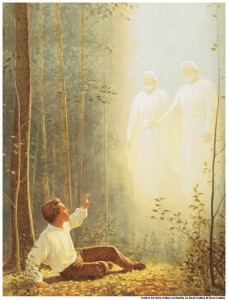
This process is often repeated several times, as the child grows up and gains a stronger ability to recognize the promptings of faith. The pattern was set for us by Joseph Smith, the first Mormon prophet of modern times. He wanted to know which church to join, and after reading in the Bible that God would tell him, he went into the woods to ask God. Both God and Jesus Christ came to him to answer His question.
Most of us won’t get that type of answer, but we can receive an answer to our prayers, just as Joseph Smith did.
Does joining a church force you to give up your right to think for yourself? Of course not. Because each member of the church is taught to find out for themselves if the church is true, they are making an informed decision. Even after making this overall choice, if they learn something they’re not sure about, they can pray about that specific doctrine as well.
If your mother taught you not to touch a hot stove, and you obey, have you given up your right to think for yourself? No, because you are still free to touch the stove, as long as you’re willing to accept the consequences. You’re simply choosing to do what you know is best for you. Mormons, and other who believe in God, are doing the same.
One example often given is that of the sonnet. The sonnet is a poem with a very strict structure. Within the strict structure, however, a great deal of originality is possible. There are millions of sonnets, all following the rules, but all unique.
Believing in God is comforting. It’s a safe and healthy comfort, unlike the artificial comfort brought about by alcohol, drugs, or other immoralities many people turn to when they are stressed or worried. People who believe in God know there is someone who loves them and knows them, who always has their best interests at heart, and who, while not taking away our personal agency, will help us if we ask for help.
A true religion asks a great deal of its members. The Mormon religion isn’t a passive one. Because it’s a lay church, each member works hard to help it function, serving as leaders, teachers, and givers of service. They are held to a high standard of behavior.
Giving up your right to think for yourself is seemingly easy (although in reality it isn’t.) People looking for an easy way through life aren’t interested in being Mormon. The moral standards are very high and, since Mormons live in the everyday world, not in a sheltered community, this means making sacrifices and fighting those who want them to lower their standards. They raise families, have jobs, do volunteer work, and are also taught to make the most of the talents they have been given. They must figure out how to do this on their own, given their unique circumstances.
Religion never promises to be easy. The Mormons expect people to work hard for their own happiness and well-being, using the gospel as a guideline, but making choices within those guidelines.
What does the Sacrament mean to a Mormon?
Tuesday, March 10th, 2009Personal Response by Bethany
To a Mormon, the Sacrament is very personal because it provides an opportunity for members to think about the great life, ministry, and Atonement of the Savior and how it applies and affects their individual lives. As written in the Encyclopedia of Mormonism, “the Sacrament focuses attention on the sacrifice for sin wrought by the Savior and the need for all those who have been baptized to maintain their lives constantly in harmony with his teachings and commandments.” The word “Sacrament” refers to the Lord’s Supper in which Christ used emblems in similitude of the sacrifice He was soon to make. Christ met with His Apostles and instituted the sacrament as written in Luke 22:19-20:
19 And he took bread, and gave thanks, and brake it, and gave unto them, saying, This is my body which is given for you: this do in remembrance of me.
20 Likewise also the cup after supper, saying, This cup is the new testament in my blood, which is shed for you.
The broken bread reminds Church members of the Savior’s body, His suffering, and that through His mercy everyone will be resurrected and given the opportunity to obtain eternal life. The water is symbolic of the Savior shedding His blood in suffering and anguish which started in the Garden of Gethsemane and ended on the cross. (more…)
The Family of Jesus Christ
Friday, February 20th, 2009The family of Jesus Christ consists of both an earthly and a heavenly component. His father, of course, is God. Jesus is literally God’s son. God is the creator of our spirits, making us all God’s children, but we all have earthly parents. Only Jesus is the literal child of an earthly mother and a Heavenly Father.
Jesus also had siblings. According to Dr. Robert J. Matthews, who, in 1974, was an associate professor of ancient scripture at Brigham Young University, we can estimate the number of siblings he had.
“We don’t know how many other children there were in the family, but the New Testament names four boys and lists some sisters. The Greek manuscripts are helpful here. Matthew speaks of “all” (Greek: pantai) his sisters (Matt. 13:56), suggesting more than two. The Greek term hai adelphia (the sisters) is used in the manuscripts, signifying a plurality-that is, three or more sisters. If the record had intended to convey that there were only two sisters, it is probable that the word pantai would not have been employed, but, instead, the word amphoterai, meaning “both,” would have been used.
Thus the household of Joseph and Mary apparently numbered at least five boys (including Jesus) and at least three girls-eight children-in addition to the parents.” (Robert J. Matthews, “Mary and Joseph,” Ensign, Dec 1974, 13)
Professor Matthews says in this article that there are two theories about these other children. One is that they were Joseph’s from a previous marriage, and that Mary stayed a virgin all her life. He points out if this were true, those children, older than Jesus, would have been the heirs to the Davidic line, not Jesus. In addition, Jesus was referred to as Mary’s firstborn child, not her only child.
It’s important to note that prophecy said Jesus must be born to a virgin. It does not say she had to remain a virgin after His birth.
The other theory is that these were the children of Joseph and Mary, making them Jesus’ half-brothers. In this case, they would be younger than Jesus.
The brothers are mentioned by name in the book of Mark, chapter six, verse 3, in the Bible: “Is not this the carpenter, the son of Mary, the brother of James, and Joses, and of Juda, and Simon? and are not his sisters here with us? And they were offended at him.”
In the next verse, Jesus responds with a suggestion of sadness in His words: “4 But Jesus said unto them, A prophet is not without honour, but in his own country, and among his own kin, and in his own house.” (Mark 6:4)
It appears He was not recognized as a prophet by His brothers at that time. In John 7, his brothers are pressuring him:
3 His brethren therefore said unto him, Depart hence, and go into Judaea, that thy disciples also may see the works that thou doest.
4 For there is no man that doeth any thing in secret, and he himself seeketh to be known openly. If thou do these things, shew thyself to the world.
Carlfred Broderick, who in 1987, was a professor of sociology at the University of Southern California, notes that when Jesus was in his hometown and the people wanted to push him off a cliff, there is no record of His brothers coming to His defense. (Carlfred B. Broderick, “The Brothers of Jesus: Loving the Unbelieving Relative,” Ensign, Mar 1987, 50)
Professor Broderick also reminds us that on the cross, Jesus turned over care of His mother to one of His apostles, not to His brothers. It was apparent none of them came to Calvary that day, to support their mother or to be there for Him.
It may be this challenge, having brothers who turned their backs on the truth, that caused Jesus to speak of the importance of finding the lost sheep and of converting others. He knew, like so many others who face the heartache of an unbelieving relative, how challenging it was to see a loved one go astray.
There was not a change of heart until Jesus was resurrected. At that time, he appeared to His brother, James. Only now, when they could see the proof of his divinity, did they have a change of heart and fully repent of their earlier disbelief. Later scriptures mention the brothers as leaders in the church, with James seeming to fulfill a particularly high role. Some wrote portions of the New Testament. It was James who wrote the scripture that launched the restoration of the gospel.
In James 1:5, he wrote:
If any of you lack wisdom, let him ask of God, that giveth to all men liberally, and upbraideth not; and it shall be given him.
Joseph Smith was fourteen years old when he read this passage in the Bible. He had been visiting various churches and trying to figure out how a person could tell which one to join. When he read this scripture, written by the Savior’s own brother, he realized this was the only way to know what God wanted. God knew which church was true. He went into woods and prayed. During the course of the prayer, God and Jesus Christ appeared to him. God introduced him to Jesus, who then instructed him not to join any of the churches, because none was entirely correct.
In a few years, when Joseph was grown, he would be mentored by an angel, who would prepare him to lead the restored gospel.
What are the Articles of Faith?
Wednesday, October 29th, 2008
What are the Articles of Faith?
Personal Response by Bethany
Background:
In 1842, John Wentworth, editor of the Chicago Democrat, wrote to Joseph Smith requesting information for a friend who was writing a history of New Hampshire. Joseph Smith’s response to this inquiry has become known as the “Wentworth Letter.” The letter includes a brief history of the Church and significant events in its restoration. It ends with thirteen statements that have become known as the Articles of Faith and are published in the Pearl of Great Price. (more…)
Does God Really Hear My Prayers?
Tuesday, August 5th, 2008Personal Response by Natalie
Yes! He really does. I have felt the powerful assurance that God does hear my prayers many times in my life. I know that the Savior’s message, recorded in the New Testament, still rings true: “Ask, and it shall be given you; seek, and ye shall find; knock, and it shall be opened unto you” (Matthew 7:7).
Last summer I was preparing to begin my first year at Brigham Young University. As it got closer to the time that I had to move out, I began to get really nervous. I worried about who my roommates would be, how hard my classes would be, and how difficult living away from home for the first time would be. I remember one night being particularly worried and stressed about everything. In tears, I knelt next to my bed and prayed to my Father in Heaven that He would fill me with comfort. Almost immediately I felt a calm assurance wash over me and I knew my prayer had been answered. I knew that the Lord knew me and loved me and that I had nothing to fear. As I continued to look forward to starting the new semester, the words of this scripture went through my mind “Look unto me in every thought; doubt not, fear not” (Doctrine and Covenants 6:36). This too, was a simple, peaceful reminder from a loving Heavenly Father that everything would be okay. (more…)
How Do I Know That the Book of Mormon Is True?
Friday, August 1st, 2008Personal Response by Lance
I have known for a long time that the Book of Mormon is the word of God, but only in the last couple of years, while serving as a Mormon missionary, was I finally able to put into words the way that my answer came. There is a promise given by Moroni at the end of the Book of Mormon that if a person reads, ponders, and prays to know the Book of Mormon is true, the truth will be manifest to them by the power of the Holy Ghost. (See Moroni 10:3-5)
I read the Book of Mormon a few times growing up and I always felt that it was true, but I could never clearly express how I had come to that knowledge. I could honestly say that I knew by the power of the Holy Ghost that the Book of Mormon is the word of God, but I couldn’t describe what that meant. It was more than just a simple feeling. It was a strong conviction.
As a missionary I came across people who had highly varying beliefs about the Holy Ghost and the way that the Holy Ghost affects us. This caused me to search even more to find a way to clearly explain how I had received a testimony that the Book of Mormon is true. I was reading in the Book of Mormon one day and I found my answer. (more…)
How Can I Recognize Answers to My Prayers?
Wednesday, July 30th, 2008Personal Response by Nathan
Answers to prayers come in many different ways. A good way to answer this question may be to explain some of the generic ways prayers are answered.
There is a method of seeking revelation (communication from God to man) that allows prayers to be answered. Seeking revelation correctly begins through effort on our part. A simple prayer is often not enough. Important steps to consider are fasting, pondering, and building faith to accept an answer. As we fulfill these steps, God will see our efforts and bless us accordingly. Often the best method of seeking revelation or answers to prayers is to make a tentative decision after our fasting, pondering, and faith building. Once we feel we have a good preliminary decision, we take the decision to the Lord and ask for His confirmation. (more…)
What do Mormons Believe about Jesus Christ?
Monday, July 28th, 2008Personal Response by Chris
Mormons believe that Jesus Christ is central to the plan of redemption, which teaches that one can be saved in the kingdom of heaven by a single vicarious act of sacrifice. We believe that Jesus Christ lives as our Savior, an example of goodness, charity, love, and other perfected attributes as recorded in the Bible and other revealed scripture. Jesus Christ in the Mormon Church is taught to have suffered for the sins of the world and to have promised forgiveness to all who live on this earth if they will hearken unto Him and do His will as laid out in the scriptures. He is the living Son of God, the Only Begotten in the flesh, and the mortal Son of Mary. (more…)
Does God feel our pain?
Monday, July 21st, 2008Personal response by Jack
At age 50 I was body surfing with my 16-year-old son and his friend at Laguna Beach, California. I took one “last wave” and accidentally hit by forehead on a submerged rock, my neck was broken, and my spinal cords severed between the second and third cervical vertebrae. I was instantly paralyzed, lost consciousness, and woke up two hours later in the Laguna hospital surrounded by doctors and nurses. One of the nurses noticed my eyes were opened and said to me, “Jack, if you can understand what I am saying, blink your eyes once.” I blinked and there was a collective sigh of relief in the room. That began for me a new way of life that has continued on for the past 19 years.