Faith Archive
by Nora Hess
When I was 16 years old, I spent a few weeks at Cornell University attending a summer program for high school students. For the first time in my life, I left the safe, comforting environment of my home to spend time with people who were very different from me. The culture shock was enormous. As a lifelong member of The Church of Jesus Christ of Latter-day Saints, sometimes called the “Mormon Church” by the media, I had grown up among people who believed as I did, who worshipped God, and who strove daily to keep His commandments. By contrast, the other young people with me at Cornell were largely agnostic: they did not pray, believe in Jesus Christ, or live the standards that I had been taught. Soon I realized that the way I saw the world was not the only way. I came face to face with the question: Why did I believe?
Faith: The Essential Questions
There comes a time in each person’s life when certain questions loom large:... Read the rest of this entry »
Of all the numbers in the Pew Research Center’s recently released survey of “Mormons in America,” the highest, most overwhelming numbers are these: 98 percent of respondents said they believe in the Resurrection of Jesus Christ, and 97 percent say their church is a Christian religion.
This comes on the heels of earlier surveys indicating that 32 percent of non-LDS U.S. adults say the LDS Church is not a Christian religion, and an additional 17 percent are unsure of LDS Christianity. The theological and semantic reasons for this can be complex, but for the 1,019 self-identified Mormons who participated in the Pew survey, their theological position is clear: Mormons believe in Jesus Christ, and they consider themselves to be Christian.
“Certainly in Latter-day Saint theology is this idea that if you understand who you are, you understand that there’s a purpose in life, you understand your connection to God, that certainly has... Read the rest of this entry »
When people struggle to know whether or not God and Jesus Christ are real, they often ask in frustration, “Why doesn’t God just show Himself?” It sometimes seems to them that if He wants them to believe in Him, that would be the simplest way.
Why doesn’t God just show Himself? To understand the answer to this question, we first have to examine why we came to earth. For members of The Church of Jesus Christ of Latter-day Saints, whose members are sometimes called Mormons, the explanation of life’s purpose begins even before birth. What happened to us before we were born explains why God seldom shows Himself today.
Mormon beliefs tell of a time before the world was created. God created our spirits. This is one reason Mormons consider God to be literally their Heavenly Father. Our spirits weren’t housed in bodies yet, although they had that form, but we did have our personalities, talents, and interests. In other words, we were uniquely ourselves.... Read the rest of this entry »
When people talk about Mormonism, they often focus in on small things that are not important, aren’t taught currently, aren’t even practiced today. By doing so they miss an opportunity to understand Mormonism as it lives today and even as it was originally taught.
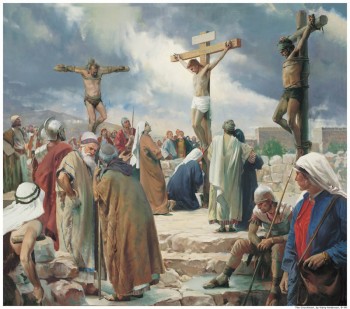
The atonement of Jesus Christ is central to Mormonism.
To understand Mormonism, you must focus on core doctrines, those things which are canonized as official doctrine and taught consistently. While church practices sometimes change, truth does not.
There are a few guidelines that can help you evaluate whether or not a teaching is a core doctrine—or even a true doctrine of Mormonism.
First, it is important to understand that every word spoken by a prophet is not necessarily doctrine, particularly in the earliest days of the church. In the beginnings, the church was run much more informally. People talked among themselves and sometimes others took notes and published those conversations... Read the rest of this entry »
Grief is part of the human experience. Opposition is necessary for growth, according to the Mormon view of our mortal experience, revealed by the Lord through modern prophets. It can, however, be lifted through the power of the atonement of Jesus Christ. Mormons believe that the Savior, Jesus Christ, not only died to pay for our sins but also to take upon Himself our sorrow, grief, and infirmities (Alma 7:11–12).
Patricia Pinegar, former President of the Primary, or children’s organization of The Church of Jesus Christ (errantly referred to by the media as the Mormon Church), speaks of her own encounter with grief and the Savior’s intercession:
The difficult experience of my son’s death helped me identify and rejoice in the blessings of peace, hope, and direction—blessings that all who truly accept and live the gospel of Jesus Christ may enjoy. I can bear witness to the words of Elder Richard G. Scott: “Please learn that as you wrestle... Read the rest of this entry »
Mormons believe that true followers of Christ are counted as “saints”–those who have followed Him into baptism by immersion through His priesthood power as held by ordained members of The Church of Jesus Christ of Latter-day Saints and who continue in the path of righteousness. Members of Christ’s Church established when he was on the earth are the early saints, and members of His Church today are referred to as “Latter-day Saints.” Many of all faiths live a Christ-like life and are saintly and good. The literal term, “saint,” however in our theology is reserved for the above.
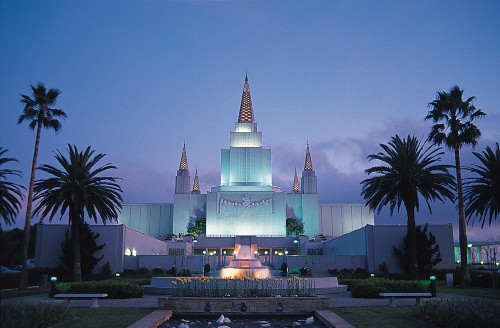
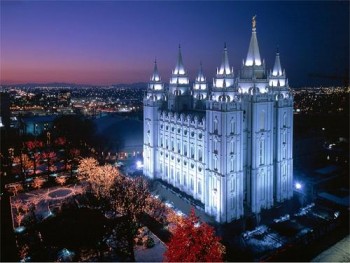
A Mormon Temple
Mormons do not beatify (call blessed in a formal sense) or canonize (declare a higher state of sainthood) anyone who is a member of the Church. Nor do we pray through or to others who have passed through this life and entered the spirit world, awaiting the resurrection. While we, like Catholics, do believe that... Read the rest of this entry »
In the strictest sense, the word exmormon simply refers to someone who chose to end his membership in the Church of Jesus Christ of Latter-day Saints. Members of the Church are sometimes referred to informally as Mormons, and so an ex-mormon is a former Mormon. However, the term is more commonly used to refer not to people who simply left and moved on, but to those who then devote themselves to attacking the church.
Read the rest of this entry »
Read More →
Recently, Elder Russell M. Ballard spoke to graduating students at Brigham Young University, a school owned by The Church of Jesus Christ of Latter-day Saints. Members of this church are often informally known as Mormons. He counseled them in ways to discuss their religion with others, pointing out
that most topics of greatest interest to detractors are not critical elements of the current religion, but are fringe elements or practices no longer carried out. He advised them to keep the discussions focused on the core of the religion, the elements that affect salvation, rather than those that are merely interesting intellectual discussion points. Read the rest of this entry »
Read More →
The Pew Forum, which is not affiliated with the Church in any way, did a study of Mormons in the United States. One aspect of Mormons in their personal lives involved their feelings about and relationships with God.
The study found that every Mormon surveyed believed in God, which was higher than any other religion previously
surveyed. In addition, nine out of ten were absolutely certain of God’s existence. Ninety-one percent of Mormons believe God is someone you can have a relationship with. All these figures are well above the normal for other groups. Read the rest of this entry »
Read More →
This question is often asked by evangelicals, and is, in general, a misunderstanding of the Mormon teachings on what happens after death and how we control that.
Many evangelicals teach that a person gets to heaven by being “saved.” This involves the act of accepting Jesus Christ as their personal Savior. At the same time, they teach that acts cannot get you into Heaven. The Mormons also believe that a person must accept Jesus Christ as His Savior in order to return to God’s presence after death. Both groups agree that at least one act is required of all of us in order to be with God.
The confusion over the number of acts required to be saved comes from the differences in terminology used by Mormons. Mormons believe everyone is saved through the atonement of Jesus Christ, even if they never accept Jesus Christ as their Savior. However, grace and eternal life, to a Mormon, are not the same thing. To understand this complex issue, let’s look at... Read the rest of this entry »